Sunday, November 8, 2009

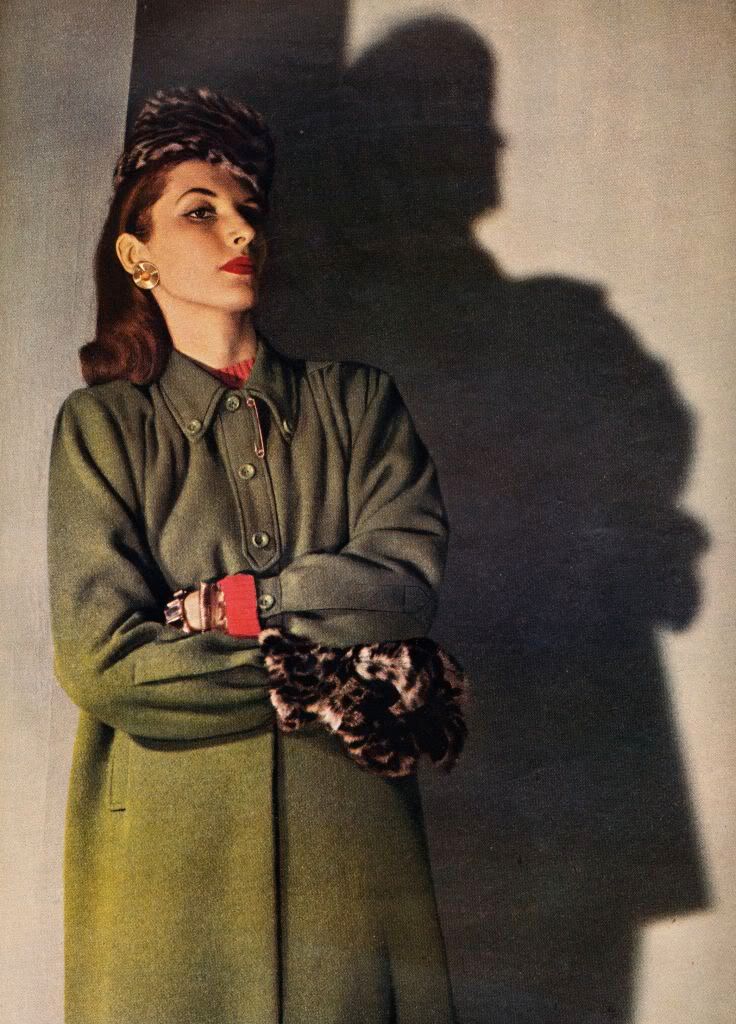
"Timeless Wardrobe, all for $100.00" 1953

In 1953 dollars you could get all this for under $100.00, now you couldn't get one piece for that...but the rose is still free, because you have chic and wit!

"Combine fashion and personal wisdom and you have
something money can't buy. Combine a bright red coat,
a smoke gray suit, a black faille dress and a simple
gray tweed and you have clothes to take you
anywhere, any time. Consider the delightful factual
sum of money spent, $99.14 and you have a small miracle.
All accessories, even the fashion-conscious cummerbund
taffeta scarf and narrow-silhouette bag are included!

The red rose was handed to you by an admirer-for your chic and your wit."
By Wilhela Cushman - Fashion Editor of the Journal


Beautiful red coat of satiny wool, lined with Milium, $34.00, by Irving Finker. Rayon-velvet beret, $1.59; plastic-calfskin bag, $2.95; gloves, $2.95.


Fashion of gray tweed, a wool-and-rayon dress, with a white collar and black satin bow and belt, $14.95, by Clara Blatt. Rhinestone clips on the beret double for earrings ($1.00). Gloves are washable rayon, $1.00. Gloves are washable rayon, $1.00.


Your afternoon and dinner dress is a separates-fashion in black rayon-and-cotton faille, by Nellie de Grab. Skirt, $8.95; top, $5.95; rayon-satin cummerbund, $1.50; rhinestone pin, 40¢.


Year-round suit of charcoal-gray rayon-and-acetate ribbed weave, $19.95, is worn under the red coat all winter. The rayon-taffeta tie, $1.00, is for the suit or coat. The felt bonnet-cloche, $2.95, is interchangeable with the rayon-velvet beret.

Saturday, November 7, 2009

Singer Sewing Book - Using your Machine Attachments - 1951 (Part 2)


Fullness with Shirring. Shirring consists of two or more rows of gathers and gives soft, rich effects. When fashion approves shirrings, your machine Gathering Foot comes into its own. Use matching thread, space rows evenly and distribute fullness equally along stitching line. The illustration here shows several ways in which fashion makes use of shirrings. Inserted shirred bands are shown in the blouse front opposite. A corded shaped band of shirring makes an interesting border treatment for the jacket at the top left. All-over shirred effects, as in the bodice and in the full coat sleeves shown, are obtained by evenly spaced rows of gathers put in before the garment sections are assembled. The generous skirt of the evening dress is not actually shirred, but is made of row after row of deep ruffling, joined with cording. Remember that shirring is always best in soft, limp fabrics, and that the allowance for making must be ample, since the gathers require l 1/2 to 2 times the finished measurement. Do not plan group shirrings for garments that must be washed often, since ironing is difficult.


Tucking and Pinking. Every one of the Singer fashion aids offers its own distinctive method of enhancing garments and accessories. On this page are shown ways for using the Tucker and the Pinker. The trim tailored lines of tucks in the blouse fronts at the top can be made in lengthwise, crosswise, or diagonal patterns, as shown, and evenly spaced, graduated or in groups. Tucking is one form of fabric decoration that is nearly always in fashion. It is attractive not only in sheer cottons and lingerie fabrics, but also in dress woolens. For tucking in children's and infants' garments. The Pinker makes the easy and attractive notched edges shown in the rosettes at the neckline and in the trimming of vest, gloves, belt and bag at the bottom. Felt is excellent for pinked bandings, since it does not ravel. Taffeta, chintz, organdie, and plastic fabrics are also practical for pinking. The dress in the center also shows the versatility of the Pinker. The applied pinked bands in neck ruffle and skirt are of two different widths and so spaced as to make an interesting crosswise accent.


Fagoting and Hemstitching fabric decoration with open-work designs and with self-trimming can provide attractive fashion details. Open work is particularly appropriate for summer clothing and lightweight fabrics, while the tubing is suitable for somewhat heavier fabrics. Both the Singer Fagoter and the Hemstitcher can be used for open-work lines. The choice depends on the effect desired. The Hemstitcher gives a narrow line of open work and does this in stitching directly on the fabric. The collar and bodice front at the top right show bow hemstitched designs appear. The Fagoter makes an open-work insertion which is applied in seams or in slashes placed to contribute to the dress design. The lines in the deep armhole and shoulder at top left, the deep ruffled cuff at the left and the ruffled yoke at center are done with the Fagoter in cross-stitch effect. Use yarn, braid, tubing, crochet cotton or embroidery floss to make your fagoting, depending on the fabric used in the garment. The Hemstitcher has another very practical and effective use. It provides the dainty edge finish of the picoted ruffles in the sheer dress at center right and the yoke beside it. This is produced when hemstitched lines are cut in half. Tubing Self-trimming with tubing can be used in a variety of ways. It, too, can provide open-seam insets, as in the diagonal lines of the blouse and the neckline shown here. The tubing, made with the Cording Foot is cut and stitched in parallel lines to give the ladder pattern of the blouse and inserted. A contrasting color used here accents this line. This arrangement may be varied by knotting each cross bar. As an edge finish, tubing is also attractive when arranged with the looped or scalloped line shown on the off-the-shoulder neckline and the cape coat below.


Fullness with Smocking. Always a favored fabric decoration for children's clothes and young effects, machine smocking is also attractive on grown-up garments and accessories where it is desirable to hold and control fullness at shoulder, neckline, waistline, etc. 'Peasant" styles can be created by using bright colored thread for the stitching. More formal effects, as at the upper right of the illustration, require stitching with matching thread. Smocking, either by hand or with your machine Gathering Foot, should be done only in fabrics that are soft enough to look well with considerable fullness. Many like to gather by machine, then decorate with a twisted chain or briar-stitch by hand over the machine gathering lines. This is especially attractive in plisse' cotton crepe, for children's dresses, blouses and skirts.


Quilting- Top-Stitching Quilting. Originally used to provide warmth, quilting is now more often used for enrichment or beautification of fabric and for purpose of design. When fashion favors quilting for wearing apparel and when you are master of your machine, the Quilter, with its adjustable Quilter Bar, can help you to make really lovely garments and accessories (see page 118). A few designs are shown here to inspire you to use this very practical means of fabric decoration. Simple block quilting, as shown on pockets, collars, cuffs, and belt here, can be very effective. For evening wear, it may be given added interest by adding sequins at the crossing of stitching lines, as in the bolero jacket and gathered skirt. Italian quilting in floral designs, as in the two other jackets shown here, especially dainty and feminine.


Top-Stitching. This is a smart and practical way to accent the lines of a garment and to give additional firmness along edge. Stitching may be done in matching or contrasting thread, according to the effect desired. A single line of stitching on heavy fabric, as in the coats at the bottom of the opposite illustration, gives a welted effect. In lighter weight fabrics, several parallel rows can be used, either in all-over effect, as in cuffs, yokes, pockets, belts and panels, or to lend importance to a line or edge.

Friday, November 6, 2009

Singer Sewing Book - Using your Machine Attachments - 1951

You know that box of odd things that came with your machine? Dig them out and get inspired!

Designers' Sketches the fashion sketches here and on the following page show how designers use the decorative finishes. Fashion is selective. One season banding or braiding is favored, the next may bring shirrings, gatherings, puffings, or flounces. These illustrations are given to stir your imagination and show the variety of possibilities in such decorations. Experienced buyers realize that the difference in price ranges of ready-made garments depends less on the cost of fabric than on the good workmanship of the better clothing. The more expensive the dress, the more certain you are to find details such as these in its construction.


Bands and Edges Edge-Stitcher. Wherever straight smooth edges and narrow inconspicuous joinings are required, the Edge-Stitcher proves its worth. Net, lace and filmy fabrics which are to be stitched together in bands or in all-over effects, such as the blouse at, top-center, are beautifully handled by the Edge-Stitcher. This attachment is also valuable for giving a crisp edge to perky ruffles, as around the neckline at bottom, and when bands of fabric, ribbon or braid are used, as in the skirt and the sleeve shown. For very fine work, use matching thread, a short stitch, and tissue paper underneath for protection.


The Zigzagger for Applique. Of all the practical Fashion Aids which the sewing machine provides, none contributes more to the beauty of both design and fabric than does the Zigzagger. With it, you can applique the most intricate, time-taking designs, doing the work even more effectively and with far less handling than by hand. This page shows you only a few of the ways in which it can serve you. The zigzag stitching line it makes back and forth across the joining is ideal for applying the shaped edges of lace to filmy fabric, as in lingerie and evening wear. For applying fabric motifs, it also makes an excellent secure and inconspicuous edge finish. Flower motifs, conventional designs, monograms may all be applied in this easy way. The particular advantage of applique is that it lends interest through contrast-contrast of textures, of color, and of design. The tracery of the outline against a plain surface is eye-catching. Velvet on broadcloth, taffeta on satin, satin or taffeta on organdie, taffeta on satin or net, net or lace on chiffon, plain cotton on printed, or plain silk on printed-these are only a few of the possible combination's you can use. On sheer fabrics, self applique gives the shadowy contrast of a double thickness. If you are not expert with the Zigzagger, go to a Singer Shop and learn how to use it for applique.


Feminine Frills Ruffles. Feminine as a powder puff, ruffles are the essence of daintiness. The infinite, variety of ways to use ruffles is just hinted in the illustrations opposite. With your machine Ruffler and Gathering Foot you can make these perfectly and with a minimum of effort. Center-stitched ruffles, applied on a curved line, are used in the round-necked blouse at the top and the evening dress at the bottom, tiered ruffles in the petticoat showing beneath the lifted skirt. The blouse front at top left has a ruffle inserted in a seam. The all-over ruffled effect in the jacket just below is obtained by applying center-stitched ruffles along parallel lines marked in the fabric. Ruffles generally are best cut on a true bias, hemmed, picoted, or lace-trimmed, then plaited or gathered. They may, however, be made of ribbon, of lace, of a bias fold. Always press your ruffle after the edge is finished and before gathering the top. Keep ruffling in a box-do not let it get wrinkled after it has been gathered.


Corded Finishes Cording. The illustrations here give you an idea of the many ways in which your machine Cording Foot can help you in achieving attractive and professional-looking details. Cording may be made of self-material or in contrasting color, depending on whether a color accent is desired or not. When inserted in seam lines, cording gives weight and importance to the lines of the garment. It also makes an attractive edge finish for collars, necklines, cuffs and jackets, as shown. Several additional rows of cording may be put in above the edge to give the effect shown in the flared tunic illustrated. Where a shirred section joins plain fabric, as in the blouse front at the top, cording may be inserted to give the joining a nice finish. The center dress and the bag show how corded shirring holds and distributes fullness, and the shirred bands at the top illustrate the use of cording to give a firm neat finish at the edges of the bands.


Trimming with Braid Braiding. The sketches opposite show a few designs for braid trimming. Make your own motifs, choose a transfer pattern, or take a rubbing from a pattern and transfer this to your fabric for the braiding lines. Learn to use both the Braiding Foot and the Underbraider expertly before beginning such work. Then braiding can give you a decorative touch at neckline or pocket. It can accent the lines of a long-torso dress or a short bolero. Braid can add distinction to a simply cut evening wrap and give a note of interest to a plain bodice or the lapels or peplum of a dressmaker suit.

Thursday, November 5, 2009

"The Hat - That flatters and hugs the head" - 1953

From The Ladies Home Journal in 1953

"New hats are small and sleek, made of glamour fabrics - fur, satin, velvet, and jewel toned velours. Definitely pretty - fashion says, this fall."
By Ruth Mary Packard


Black broadtail beret with braid, made for an autumn-leaf-red wool suit, both by Hattie Carnegie. This sleek little hat is perfect fashion for black costumes or any bright color.


Blond velvet beret and gloves match collar of Hattie Carnegie's suit, bag by Ben King.


Winged toque in satin and velours by Christian Dior - New York, worn with Maximilian's mink jacket, bittersweet velvet gloves.


Passementerie on satin - Lilly Dache's horseshoe helmet worn with Tina Leser's costume of black velveteen with green taffeta bow-blouse and long taffeta gloves.


Pleated wool Paisley in a new turban by Gladys and Belle, with matching gloves, jersey costume by Hannah Troy.


Leopard-velveteen cloche by John Frederics, bittersweet dress by Lotte, Koret bag.


Ruby-red pillbox with a rhinestone pin by Hattie Carnegie. Bracelets of black fox circle the black capeskin gloves.

Wednesday, November 4, 2009

Beginner's Luck - Easy Vogue Fashions from 1953

Just look at these very cool Vogue patterns from 1953...choose your favorite!

""Sewing bees" are back in favor...with a honey of a reason! Joining friends for an afternoon or evening of needlework is so sociable and so common-sensible. Beginners in the teen and young-married set, and experts, too, tell us of pooling talent and equipment - steam iron, button-hole attachment, sleeve board, even a group baby-sitter. Everyone gets more done at less cost, and pinning up and fitting are so easy with friends to help. These patterns are easy in any case, for either a first-timer or a practiced hand. Not only simple to make, all are so beautiful they put sewing bees in our bonnet. We can't choose one favorite; we think you'll want to sew them all up."
By Nora O'Leary - Pattern Editor of the Journal


What could be prettier than a slim camel-color wool-gabardine dress? Note the easy-to-fit dropped shoulder, trim round collar. "Easy to Make" Vogue Design No. 8107, 12 to 20.


Separates are a "natural" for a beginner. Try a pretty wool-jersey blouse, Vogue Design No. 8054, 12 to 20. Quaint flowered corduroy skirt, No. 8109. Both "Very Easy to Make".


Practical "winter cotton" in a short sleeve classic. Vogue Design No. 7768, 12 to 20. Angora-and-wool jersey bolero, stripe lining. No. 7912, 12 to 20. Both "Easy to Make".


For quick results...for your first try...a simple skirt cut in four gores. Search for a wonderful plaid, wear it with your favorite sweater. "Very Easy to Make" skirt, No. 8092.


For your first fall dress make a brown-and-white tweed. This dress is bound with braid. "Very Easy to Make" Vogue Design No. 8108, 12 to 20. The fringed stole, No. 8101.


This navy serge could be made in an afternoon. The ribbing, available in dime stores, looks professional. Add novelty belt. "Easy to Make" Design No. 8083, 12 to 20. Hat, No. 7929.

Tuesday, November 3, 2009

"How To Sew For Your Doll"

This booklet could be found in some early 60's Advance patterns. Of course it's aimed at new sewists, but the general rules work for anybody. Just remember "The PRETTIEST side is always the "right" side."


Monday, November 2, 2009

"Variety fitting the hour, the need and your personal flare" 1953

Variety Fitting the Hour from Ladies Home Journal in 1953.

"Beautiful future for black with white, bittersweet and flame...for wool with satin, velvet, fur...Variety fitting the hour, the need and your personal flare."

"Black is the significant color, from slipper satin and broadcloth to tweeds textured or flecked with black. The white accent may be fur at your neckline, a satin turban, a taffeta blouse. Bittersweet is a flaming color, the exciting extra in your plan. You can wear it in a coat, or sparingly in a pair of gloves. Maple-beige, charcoal and Puritan gray are quiet shades inviting imaginative accessories. Stand-away collars leave the throat bare or are filled with ropes of gold. (Rhinestones set in gold have a new sparkle.) Gloves are longer, often pulled above the elbow, or over long tight sleeves. The newest bag is the wafer-thin box."
By Wilhela Cushman - Fashion Editor of the Journal


Black broadcloth suit with white mink, by Adele Simpson, turban by Gladys and Belle.


Broadcloth and satin - the v-neck sheath with panels in motion by Christian Dior - New York. Worn with satin-bow hat, rhinestones, long capeskin gloves, pointed-toe sandals by David Evins.


Winter suit with short lynx-lined coat by Lo Balbo.


Plaid tweed bolero costume with satin, by Jo Copeland.


Maple-beige camel's-hair-and-wool jacket suit, Alvin Handmacher.


Wool-and-alpaca coat by Nat Bader, satin hat, leopard muff by I. J. Fox.


Empire bolero suit by Omar Kiam of Ben Reig, muff-bag by Selma Robinson.


Hattie Carnegie's pink-and-black flecked suit with matching hat, blending velvet scarf. Worn with rhinestones, cocoa suede gloves, pagoda suede bag.

Sunday, November 1, 2009

"Dynamic Dash" - more from McCalls Magazine 1934

"Dynamic Dash - is the spirit of design for day".These are just too wonderful..."Mad, merry fashions are in order."

No. 7826. Dashing in the casually careless way of Youth. The collar and the wide plaid bow are the dynamic type of thing that call forth comment from one and all. The cuffs carry on in the spirit of the design.

No. 7848. A triumph of slimness for days when the mood dramatic descends upon you. The neckline forms a capricious bow to give you a naive, well bred air. Sleeves break into contrasting fullness at the elbow.

No. 7843. Long, languorous summer days should find you coolly swept with a picturesque chic. The shoulder yoke describes a casual curve as it cuts a cunning kimono sleeve. Ruffles form a crisp caressing neckline.

No. 7821. You'll need a host of colorful 'daytimes'for the good old summertime. Shoulder capelets lend silhouette symmetry. Short sleeves are casually chic. The skirt is panel plaited and tailored into trimness.

No. 7838. The Tunic silhouette will make you the talk of the Town! It has an eager young swagger and a delightful habit of outlining your best contours. The short sleeve, rolling collar and brisk bow are very chic.

No. 7836. Summer is Courting Time for young feminines who have the right appeal. Mad, merry fashions are in order. This dress creates the correct mood. Dashing, slim, two-piece, it is of the mode of motion.

Saturday, October 31, 2009

Magic Halloween! 1928


Friday, October 30, 2009

"The Jacket Dress" 1934

"The Jacket Dress provides complete costume chic" from McCalls Magazine in June of 1934. Don't miss the descriptions..."fairly glistening with fashion prestige"

No. 7825 Maedchen in a Uniform of Fashion. The Jacket Dress, without which neither you or your popularity will be complete. Ruffles cascade about a demure neckline to form a collar. A split capelet sleeve waves in the wind. The peplum ties appealingly.

No. 7846 Just a jabot! But what a smart difference it makes as it spreads wings from a roundly rolled collar. The dress is trimly tricky. The jacket is short and symmetrical with a split sleeve that is designed to expose a circle of frothy fullness.

No. 7850 The redingote, slim of line, trim of detail! It slips off and you have a dress, subtly soft, freshly formal and fairly glistening with fashion prestige. The link cuff sleeve of the coat expresses the modern mode. The bodice bow is fetchingly feminine.

Thursday, October 29, 2009

"Country Club Chic" - 1934

"For any sporting occasion" from McCalls Magazine, June 1934. Note that the green and the yellow dress are the same pattern.

No. 7824. Country Club special! A dress that will mark you for attention on any veranda or sauntering along any street. The Buster Brown bow, the sleeve, the pocket all hove a way about them. Buttons march into a colorful closing.

No. 7837. Do you live in a sports silhouette all summer? Well, here is one that will spotlight you in simplicity. The roundly high neckline buttons down as low as you will. Stitched tucks give a straight forward line to the silhouette.

No. 7820. There's more than a dash of magnetism in this lively new sporting silhouette. The haltered sun back is just right for a love set at tennis. A butterfly bow will help you scintillate as you sit bock to enjoy the summer sunshine.

Wednesday, October 28, 2009

"Lady of Fashion - Summer Style " - 1934

More from McCalls Magazine, June 1934. The "Lady of Fashion - Summer Style, slim, straight, sheer with crisp touches of white."

No. 7827. Lady of Fashion Summer Style. The new, one sided silhouette is expressed in a ruffled flounce that cuts a chic line across the bodice. The skirt is the latest expression of rhythm in the windswept mode.

No. 7828. The spinning silhouette rotates into a mode of motion! A high in back, pulled to-the-side-in-front neckline provides demure exposure for warmly windy days. Streamer sashes fly from neckline and waistline.

No. 7853. It comes from Irene Dana, this piquant fashion, and brings with it cool charm. The double collar forms a winged jabot. The sleeve ends in a copious cuff. A petal like peplum has an appealing air.

No. 7854. For the woman who chooses her fashions with care and an eye to individuality. The asymmetric neckline emerges into tiered jabot. The sleeve will do you proud atop any table. The skirt is slim and straight.

No. 7847. A fashion so romantic, so glamorous that, willing or not, you will be swept toward many an amour. The collar is a flower-like frame of tiered petals. The sleeve is billowy at the elbow, rippling at the cuff.

No. 7829. Two piece? Not really! For you who like to have your pie and eat it too...a one piece dress with removable peplum. The dropped shoulder line and elbow puffed and cuffed sleeve are smartly in season.

Tuesday, October 27, 2009

"Covered Shoulders have a new captivation" - 1934

From a lovely spread in McCalls magazine in June of 1934. The gowns are amazing, as are the descriptions. Please note that the flowered print and the pink are the same dress.

No.7858. Interlude divine, in the day,of a modern maiden. A high neckline .. a covered shoulder will give subtlety to your appeal. And when you rise, your cue is rhythmic motion.

No. 7839. Femininity is on parade at eventide. Shoulder ruffles cascade into a capelet. A wide sash is softly definitive. But the secret of the Augusta Bernard chic lies in the tiered skirt.

No. 7852. The dinner hour has become fashionable for its intime atmosphere. The collar is set to stand in calla-lily
fashion. The bodice is a clinging contour that shapes into a vee waistline.

No.7857. Dancinq dress in the Mainbocher manner! The cushion collar exposes the crest of the shoulder as it cradles the arms. A butterfly bow and a vee decolletage are captivating.

How I look during my "Hours of Leisure"

Just whip this out and darn in some angora for the floral decorations...then relax in style!

Saturday, October 24, 2009

Butterick Fall Holiday Fashions - 1955

Slim or Full skirts, in great fall colors, getting ready for the season!


Thursday, October 22, 2009

"Excuse My Dust"

It's a long story, but we have been in one place for a long time and are finally on the road again...at last!

Wednesday, October 21, 2009

Originator - Smart Fashions - 1946 (Part 6)


And last but not least these amazing gowns...

Tuesday, October 20, 2009

Originator - Smart Fashions - 1946 (Part 5)

While you are looking over these sketches don't miss the hats, shoes and hair-dos!


Monday, October 19, 2009

Originator - Smart Fashions - 1946 (Part 4)

Here are some gals with attitude!


Sunday, October 18, 2009

Originator - Smart Fashions - 1946 (Part 3)

Be sure to enlarge these to get all the details!