Showing posts with label 1941. Show all posts

Tuesday, September 15, 2009

Seat Covers For Dining Chairs - 1941

Another swell project from Ruth Wyeth Spears, from Sewing Book 1, 1941. These could be very formal or jaunty and cheerful...whatever you want!

"Give your dining room chairs a fresh start with seat covers of substantial, firmly woven cotton material. A plain color in an interesting weave or a fabric with a small figure is most suitable.

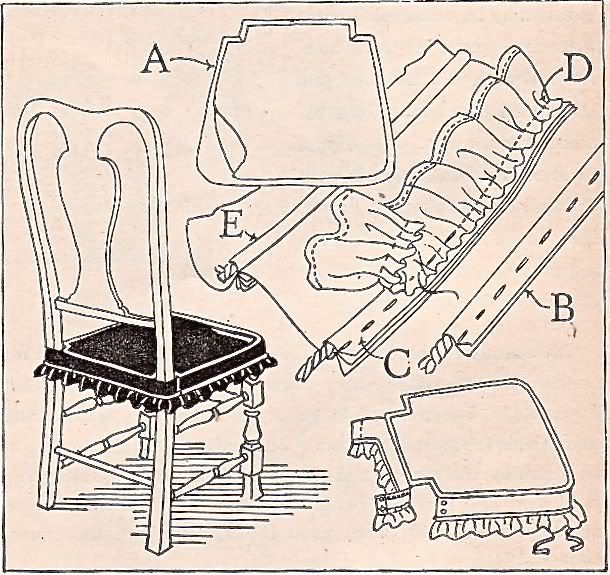
To make a pattern for the covers, place a sheet of paper on the seat and press it down along the chair edges to make an imprint of the seat outline. When using this pattern add a 2-inch seam allowance as at A. A straight band covers the wood frame at the sides, and a narrow fringe or frill may finish the bottom.

Give the covers a professional finish with welted seams. The cable cord for the welting is covered with bias strips of the material or with bias trim as at B. This is basted to the right side as at C, and then stitched as at D. A finished welted seam appears at E. Tapes are sewn to the inside of the front corners to be tied around the legs. Snap fasteners are used for the closings."

Monday, September 14, 2009

"It's Easy To Make An Ottoman" - 1941

Since I'm thinking you have more energy this week than I do (pass the orange juice and asprin, please), you go right ahead and make an Ottoman...cover it with something fantastic and then invite us all over for tea. Of course you'll need to have a "woman who is clever with the needle, aided by the man who is handy with tools".
This is from "Sewing Book 1" by Ruth Wyeth Spears, this booklet is from 1941. This one seems to have a lot of household projects, so get ready to transform your home.

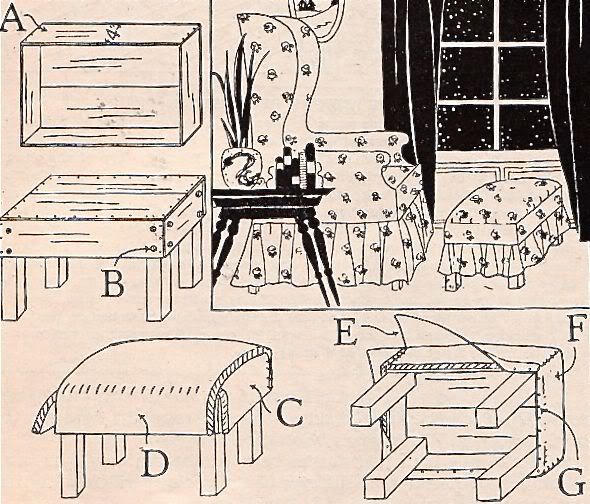
"The woman who is clever with the needle, aided by the man who is handy with tools, can make this ottoman for almost nothing. The foundation is a 4-inch deep wooden box as at A. For legs, use lengths of wood cut two inches square, which you can obtain from any carpenter or lumberman, or cut down a set of legs from an old table to the correct size.

Cotton batting is needed for padding. Use six layers on the top, cutting the first layer 4 inches smaller all around than the top of the box, and the others each a little larger than the one underneath; cut a piece to go over the top and ends, as at C, another to go over the top and sides as at D. Stretch a piece of muslin over the padding, cutting the corners as at E. Sew as at F, tack the bottom as at G.

The ottoman cover may be finished with a frill, to match a slip-covered chair, or a tailored effect may be achieved with braid or fringe."