Thursday, May 1, 2014
Four Stylish Tailored Suits from 1927

Saturday, June 25, 2011
Today's Housewife - 1927 -Applique and Embroidery Trims the Newest Drapery
(Click twice for details)
Friday, June 24, 2011
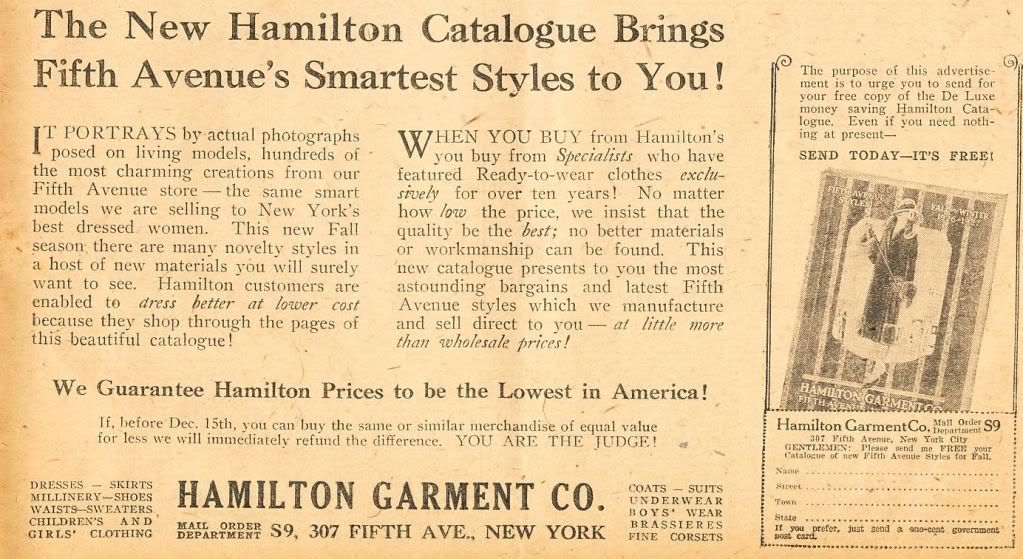
Today's Housewife - 1927 -The New Hamilton Catalogue!
Monday, June 20, 2011
Today's Housewife - 1927 - Smart Fall Frocks + Slender Lines in Smart Styles
514-Suggests Two-Piece Mode. Cuts in 36, 38, 40, 42, 44 and 46 bust. 36 bust requires 4 vards of 36-inch material with 3/8 yard of 40-inch contrasting.
490-One-Piece Dress., Cuts in 16 vears, 36, 38, 40, 42, 44 and 46 bust. 36 bust requires 2 7/8 yards of 40-inch material with 3/4 yard of 32- inch contrasting.
469-Youthful design. Cuts in 16, 36, 38, 40 and 42 bust require 2 5/8 yards of 40 inch material with 2 yards of contrasting.
238 Smart Lines. Cuts in 14, 16 years, 36, 38, 40 and 42 bust. 36 bust requires 3 1/8 yards of material.
465 Smart All-Occasion Frock. Cuts in 16 years, 36, 38, 40, 42 and 44 bust. 36 bust requires 2 3/4 yards of 54-inch material with 1/8 yard of 40-inch contrasting.
252-One-Piece with inverted Plaits. Cuts in 16 years, 36, 38, 40, 42 and 44 bust. 36 bust requires 2 3/4 of 54-inch material with 5/8 yard of 36-inch contrasting.
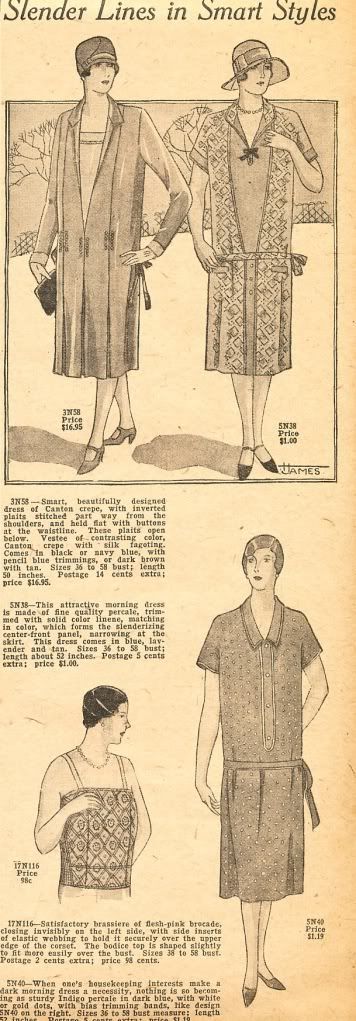
3N58 - Smart, beautifully designed dress of Canton crepe, with inverted plaits stitched part way from the shoulders, and held flat with buttons at the waistline. These plaits open below. Vestee of contrasting color, Canton crepe with silk fagoting, Comes in black or navy blue, with pencil blue trimmings, or dark brown with tan. Sizes 36 to 58 bust; length 50 inches. Postage 14 cents extra price $16.95.
SN38-This attractive morning dress made of fine quality percale, trimmed with solid color linene, matching in color, which forms the slenderizing center-front panel, narrowing at the skirt. This dress comes in blue, lavender and tan. Sizes 36 to 58 bust, length about 52 inches. Postage 5 cents extra; price $1.00.
17NI16-Satisfactory brassiere of flesh-pink brocade, closing invisibly on the left side, with side inserts of elastic webbing to hold it securely over the upper edge of the corset. The bodice top is shaped slightly to fit more easily over the bust. Sizes 38 to 58 bust. Postage 2 cents extra; price 98 cents.
5N40 -When one's housekeeping interests make a dark morning dress a necessity, nothing is so becoming as sturdy Indigo percale in dark blue, with white or gold dots, with bias trimming bands, like design 5N40 on the right. Sizes 36 to 58 bust measure; length 52 inches, Postage 5 cents extra; price $1.19.
Friday, July 16, 2010
More Pockets! Lot's of Pockets! from Butterick's "Art of Dressmaking" - 1927
Thursday, July 15, 2010
Pockets! Lot's of Pockets! from Butterick's "Art of Dressmaking" - 1927
Well, I bet to differ, but some of these do look fearsome. But if Butterick says you can do it, well, get busy and make some pockets!
(More tomorrow!)
Wednesday, July 14, 2010
"How To Take Measures" - Butterick - 1927
Sunday, April 18, 2010
The Woman's Institute - Children's and Maternity Garments - Part 4

"An attractive short negligee, generally known as a bed jacket, is shown in Fig. 4. It consists merely of a rectangular section of material cut according to the diagram at the upper left and having all its edges bound with a harmonizing color. As such a garment does not receive hard wear and as a dainty effect is desirable, the light colors, such as flesh, pink, blue, orchid, and yellow, are preferred. Any of these, bound with a lighter or a darker shade or with a color that combines well with it, such as orchid with pink or yellow, would be most effective. Tiny flowers, made of narrow ribbon or heavy embroidery floss in pastel colorings, provide a dainty trim around the neck and on the sleeves, while two-tone ribbon forms ties at the front neck and the under arms."
"Proper-fitting, adjustable brassieres are an actual necessity for the prospective mother. These may be of various types, depending on the figure, and the adjustment may be in the front or back, as preferred. In Fig. 1, views (a) and (b) show brassieres suitable for the large, full figure, view (a), made entirely of a figured sateen, being the type that closes in the back with waist-Iine ties fastened in the front, and view (b), the front opening type fastened with hooks along the side-front seam and made further adjustable by inserts of elastic webbing. Such a brassiere becomes useful as a nursing type after the baby's birth."
I looked and looked at this illustration and finally figured that the "great convenience" for the mother was the use of ties that "certain authorities" recommended and this illustration was the layers that you set out for one change of clothing, "each one fastened securely without turning the baby once".

"Certain authorities, interested in baby welfare and advocating simplicity of cut in garments, recommend opening them their entire front or back length, but front preferably, and fastening them with tape rather than buttons and buttonholes, as shown in Fig. 37. Such a plan proves a great convenience to the mother, for the garments can be arranged in their right order, one on top of the other, as shown here, the baby then slipped into them with great ease, and each one fastened securely, without turning the baby once. The chief essential, in using such a layette, is to see that each article is arranged smoothly with shoulder lines together so that, when the tapes are tied, there will be no wrinkles to smooth out.
Patterns for layettes of this kind can be procured, so, if you are interested in using garments that will require very little handling of the baby in putting them on and taking them off, it is well to make such a layette. Of course, it will be necessary for you to sacrifice your desire for attractive little dresses and slips, as such a plan necessitates plainer, more substantial garments, and a full-length opening naturally prevents the dainty trimming effects that make baby clothes so pretty."
This includes photos and complete instructions to make most of the items shown, after all you were expected to become an accomplished seamstress using these books. But this next drawing with some of the accompanying photos show how much detail went into garments, even for a childs underwear!
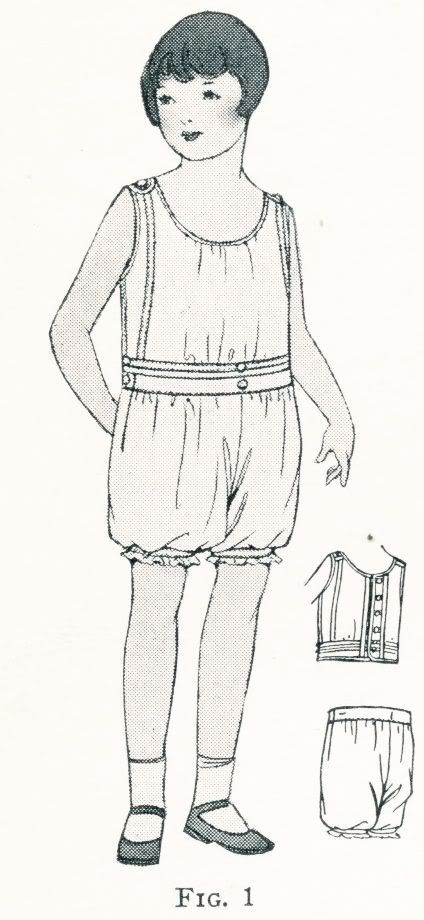
"Some mothers consider it practical to buv underwaists ready-made, and when time is a very important itern they are fully justified in this idea, for the amount of labor that is involved in their development should be a important consideration for busy mothers.
From the standpoint of actual cost, however, the making of underwaists involves a saving. Then, too, the quality of material used may be of the best and the labor may be reduced to a minimum if sewing-machine attachments are employed and the style illustrated in Fig. 1 is followed."
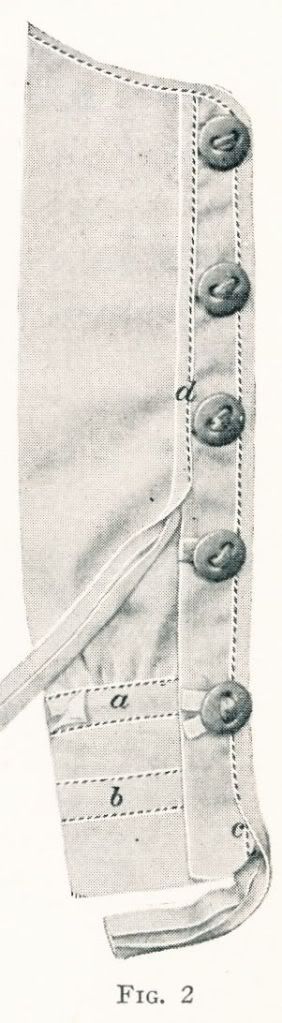
This bit about Blouses for boys explains exactly how much embroidery you may add "to very good effect", but don't get carried away and don't add any after the age of 6!"

"Blouse for boys are of two general types; the overblouse of the jumper, middy, and Russian-blouse type, and the tuck-in blouse. Both of these types are worn interchangeably with the same trousers, making greater variety possible.
Overblouses, with the exception of middies, are suited only to boys of 6 years or less. Middies may be worn by boys up to 12 years or even older, with either long or short trousers. Tuck-in blouses, being more in the nature of shirts, are suitable to boys of all ages. Sometimes in suits for boys of from 2 to 4 years, they are sewed to the trousers at waist line, making a one-piece suit in two-piece effect.
A great many variations in cut and trimming are possible within the narrow limits of these two types of blouses, so that the mother who is alert to individual touches may have them in plenty on her little son's suits. Though embroidery is considered feminine, it is possible to use small amounts of it to very good effect on the blouses of small boys, if carried out in conventionalized designs with simple stitches. Finely plaited frills and tiny jabots are not objectionable on very small boys, nor are tucks and stitched-in plaits in the fronts of blouses. When a boy passes his sixth year, however, the more tailored and masculine his clothes are, the better he will like them, and the more suitably dressed he will appear."
Thursday, April 15, 2010
The Woman's Institute - First Steps In Dressmaking - 1927
I will show a few images and words of wisdom from each of these volumes. This is the first installment.

" To dress well is an art that is acquired chiefly by study. The ability to recognize the small, important things in dress, the patience to exercise care in details, with an appreciative eye for effect, and the ambition to forge ahead by constant thought and application are qualities worthy of cultivation. So long as figures, fashions, fabrics, and individual needs change, just so long will it be necessary to study the art and essentials of dress.
Any woman who is dressed inappropriately or in ill-fitting, badly made clothes loses a great part of her charm; and this fact alone is sufficient reason why no woman should ever allow herself to appear at a disadvantage. Well-fitting, well-made garments of the cheaper materials appropriate for the occasion or the need look far better than ill-fitting, poorly made garments of expensive fabrics."
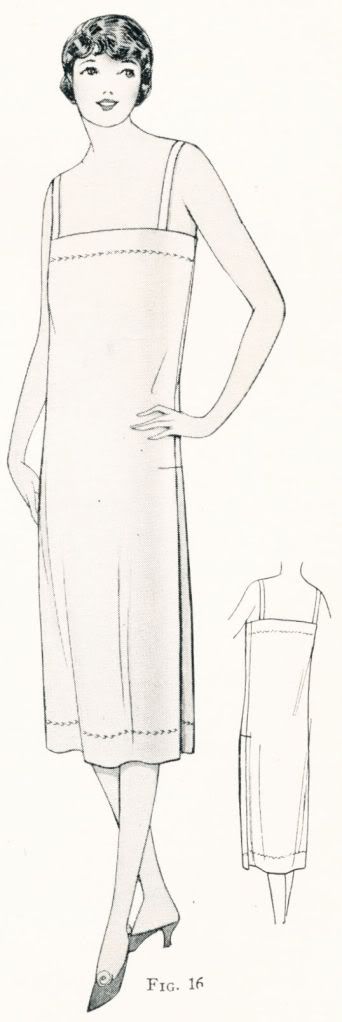
"The costume slip fills a very important place in the wardrobe, covering, as it does, the need for both petticoat and corset cover. It is simple to make and to wear, may be developed from a minimum of material, and is easv to launder. It may be trimmed as elaborately or as simply as one desires.
The slip shown in Fig. 16, is one of the simplest of these garments as regards both cut and trimming, since it is cut without a pattern and uses only feather-stitching for decoration."
" If, in marking a skirt or slip for yourself, there is no one at hand to aid in marking the length, you may use a yardstick, as shown in Fig. 21 (b), or any straight stick, and mark the length yourself with tailor's chalk.
Stand the stick upright on the floor with one end touching your figure, and make a mark on the skirt at the point on the stick that is in line with your hip line. Then move the stick around the figure, placing marks or pins a few inches apart at this same point. By tying a string around the yardstick at the point at which the chalk marks are made, you will be able to locate it readily when working at the back of the skirt. While the slip is still on the figure, turn the lower edge at the center front to decide on the length. Then remove, and measuring down the same distance from each mark, place pins.
Next, replace the pins along the lower edge with basting, adjusting, the lower edge if it seems uneven. Lay the slip on the table or over the end of a sewing machine or ironing board, and complete the hem"
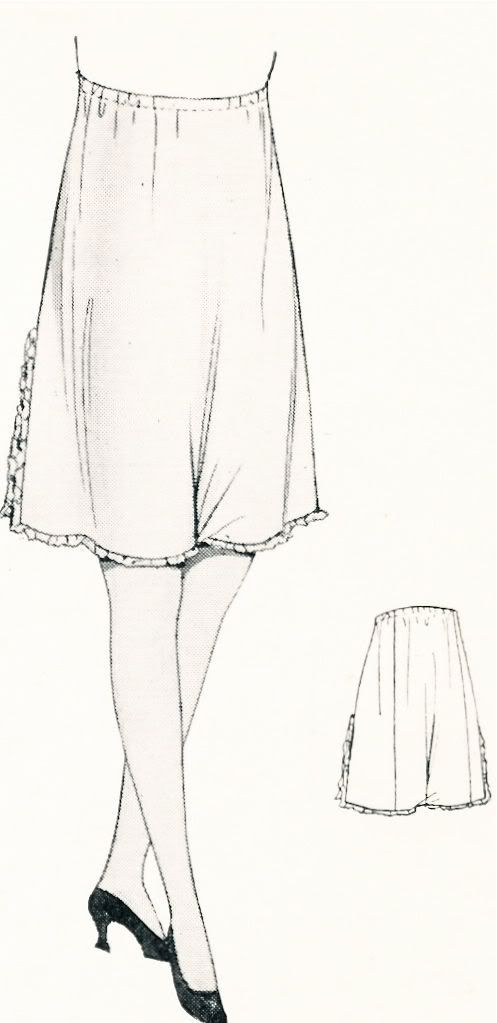
" Becatise they eliminate the need for an extra pair of straps over the shoulders, short step-ins, such as are illustrated in Fig. 22, have become very popular, particularly for wear with the costume slip. Because they are dainty, easily laundered, and not bunglesome to wear, many women prefer them to bloomers and all other forms of drawers." 
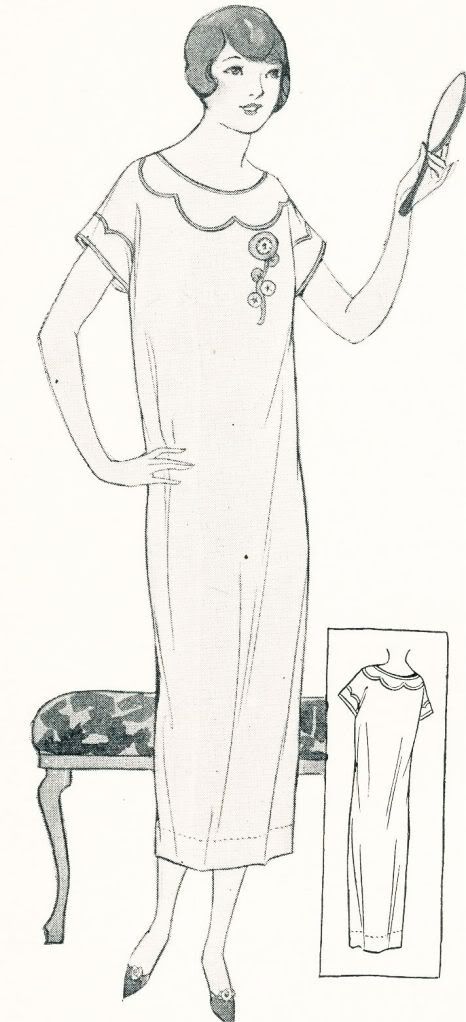
" A nightgown that has the advantages of rapidity of cutting, case of making and distinction of style, is shown in Fig. 23. Its trimming effect, gained by the use of bias binding in harmonizing colors, gives a definite appeal and, because it is so easily applied, adds very little to the time necessary for making the nightgown."
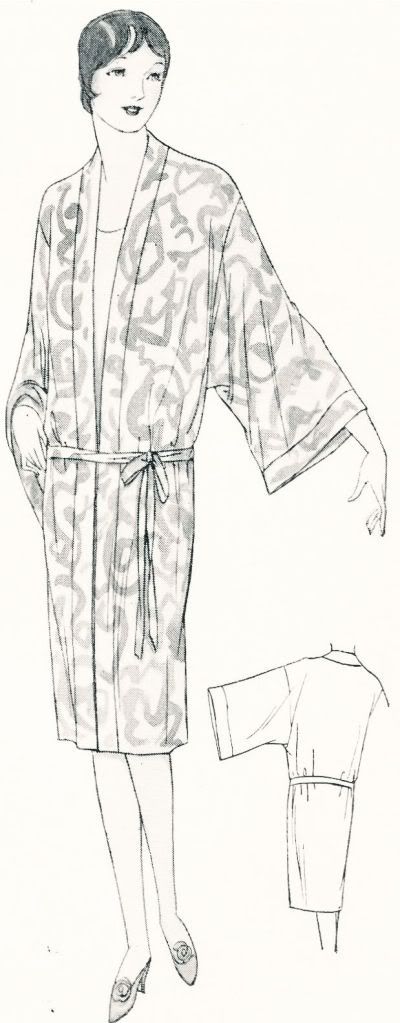
" Simplicity of construction is one of the commendable features of the very attractive drop-shoulder kimono shown in Fig. 27. A without the use of a pattern and in a very short time, you can make a duplicate of this garment which will both fill a real need and provide you with a charming negligee."
Sunday, April 11, 2010
Art Of Dressmaking - Sewing Machine Advice - 1927

THE SEWING-MACHINE
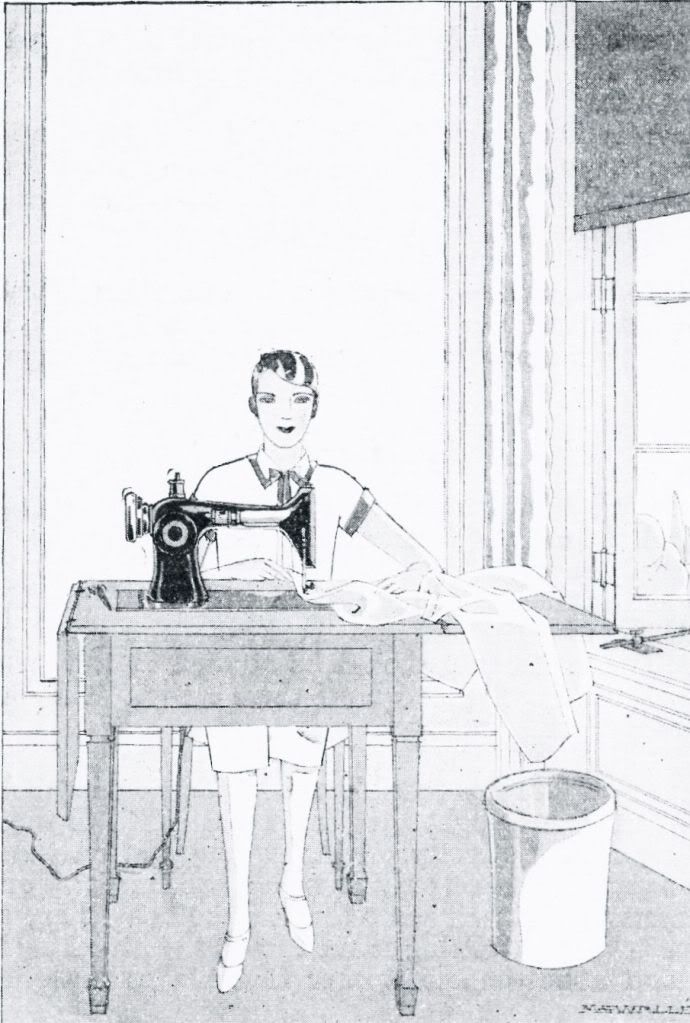
"It may be taken as a matter of course that any one who does dressmaking has a sewing-machine, but many people own machines for years and never learn how much a sewing machine can accomplish, the many almost unbelievable things it will do and the real economy in its use.
Whatever make of machine you own, the company which made it is the best authority regarding its care and operation. Their book of instruction is your best aid in becoming thoroughly familiar with the machine itself, the places for oiling, the needed adjustments of needle, bobbin or tension screws, and especially with the various attachments that can be used for so many fascinating methods of finishing and trimming garments and accessories.
If you have bought a new machine, read the instruction book from beginning to end before using it. Then take a few pieces of material, thread up the machine and experiment. Try it out not only on plain stitching but with all the attachments, making yourself familiar with their possibilities.
If there are points you do not understand, after reading your book of instructions, ask the personal instructor at the shop where you bought the machine to help you; or, if you are not near enough for this, write to the manufacturer and explain your difficulty.
If you have had a machine for some time, but are not getting the best results, begIn is though it were new. Read the instruction book and then ask for any needed help from your local sewing-machine shop or from the manufacturer.
Sometimes just cleaning and oiling, tightening the belt, or readjusting the needles or tension will correct what seemed to be a serious difficulty; yet a small thing of this kind sometimes causes a machine to remain unused for long periods of time.
Keep your machine in a convenient place in the sewing-room so that it is always ready for emergency seams, for mending, and for the occasional readjustments of clothing that come so frequently, especially in homes where there are children."

Thursday, February 25, 2010
Flapper Apron, Costume Slip, Baby Bunting - 1927
Sunday, January 17, 2010
Chicago Mail Order Catalog ad - 1927

"The attractive coats shown here are splendid examples of the alluring fashions and unusual bargains you will find in this interesting book-a perfect guide to styles. Every page of our great Fall and Winter Style Book and Family Outfitter offers YOU a saving. For almost 40 years we have been building better value into wearing apparel for the entire family, at lower prices than you would ordinarily expect to pay for stylish merchandise of Guaranteed Quality. Our aibility to make tremendous purchases at great savings, our control of sources of production and our willingness to sell in large quantities at a very low percentage of profit assure you that everything you buy will give you that service and satisfaction you have a right to expect. 3,500,000 customers have learned to depend upon the Chicago Mail Order Co. for finer styles, better quality and lower prices. Send for our big Catalog-it's Free."
Sunday, October 4, 2009
Friday, August 28, 2009
Needlecraft Magazine - The latest fashions from 1927

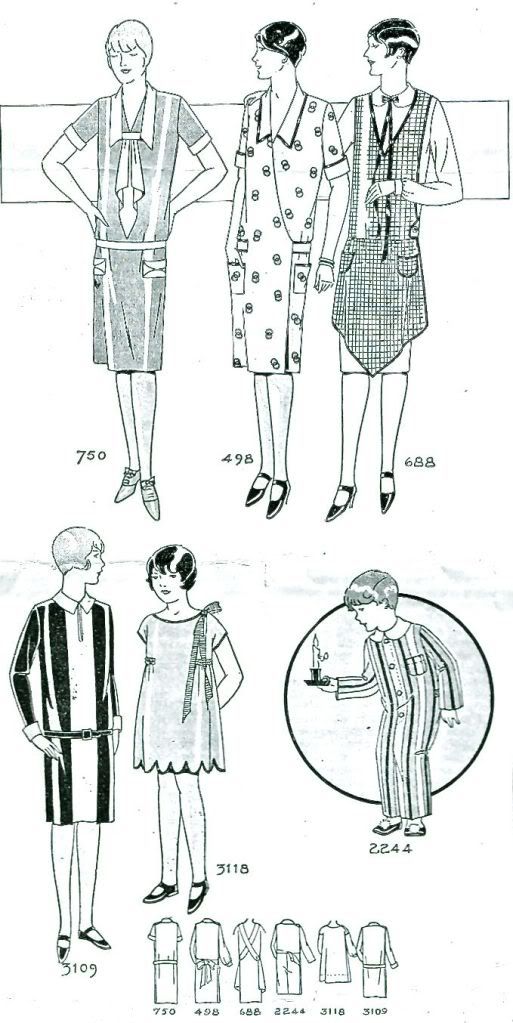
Morning or Sports-Dress
Simple, slenderizing model with youthful neckline, finished with vestee and attached jabot. The dress, No. 750, is designed for 36, 38, 40, 42, 44 and 46 inches bust-measure.
House-Dress
Attractive one-piece dress, for mornings with surplice-closing and large patch-pockets. The dress, No. 498, is designed for 36, 38, 40, 42 and 44 inches bust-measure
Company Apron
A entirely new idea in an apron design is, seen in style No. 688. It is just as practical as it is attractive. The apron No. 688, is designed for sizes small, medium and large.
For the Smart Junior
Any little miss would be glad to be the proud owner of a dress such as this. The dress, No. 3109, is designed for 6, 8, 10 and 12 years.
Typically French
Straight from Paris, featuring the new round neckline, scalloped hem line ind yoke-effect made by the soft shirring at either side of front. The dress, No. 3118, is designed for 2, 4, 8 and 10 years.
Comfortable Sleep-Ins
A little sleeping-garment is most healthful because it is most comfortable. The garment, No. 2244, is designed for 2, 4, 6, 8, 10 and 12 years.
Tuesday, June 2, 2009
Tuesday, May 5, 2009
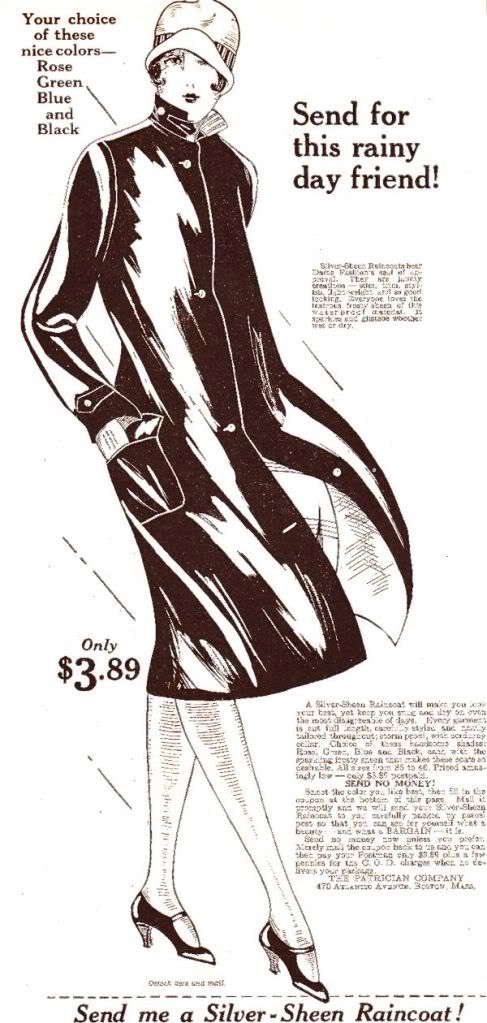
"Send for this rainy day friend!"