Monday, December 12, 2011
Last Minute Gifts - Kleenex Box Covers!
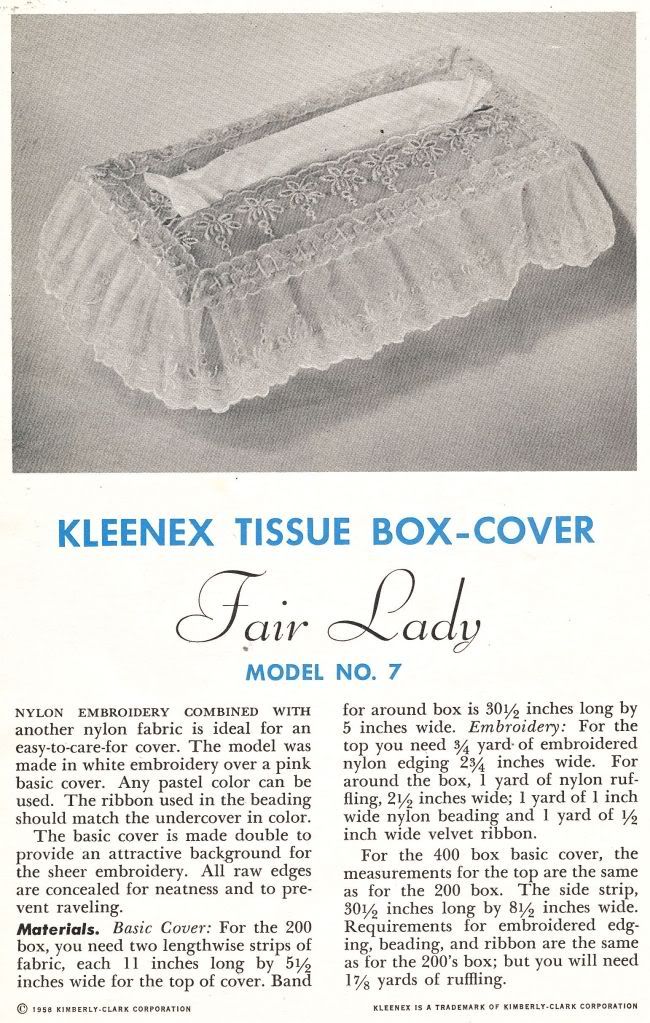
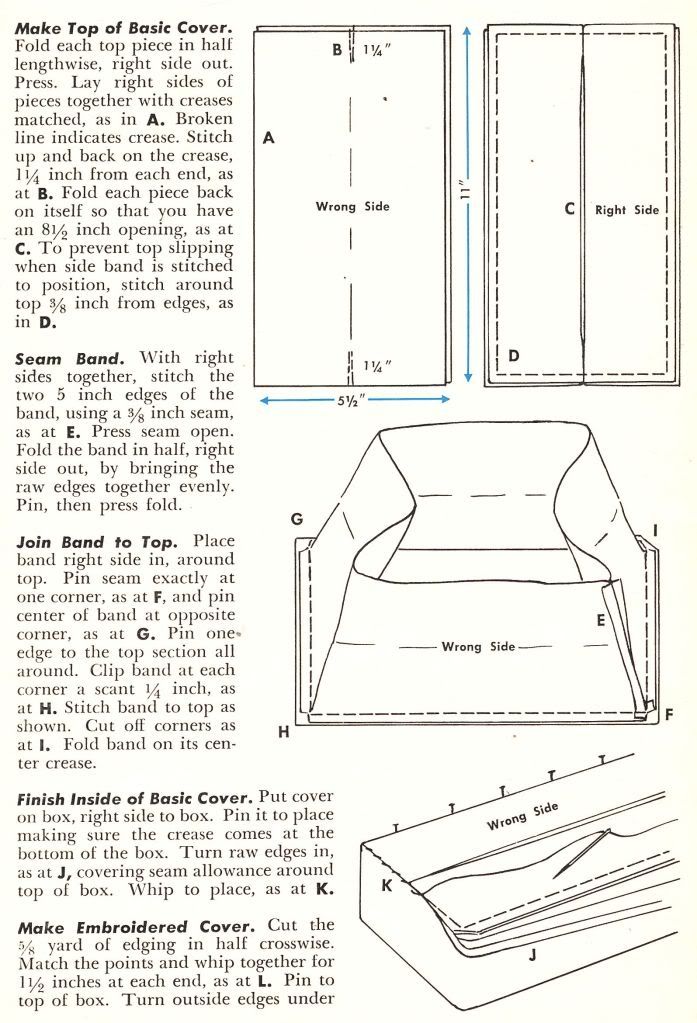
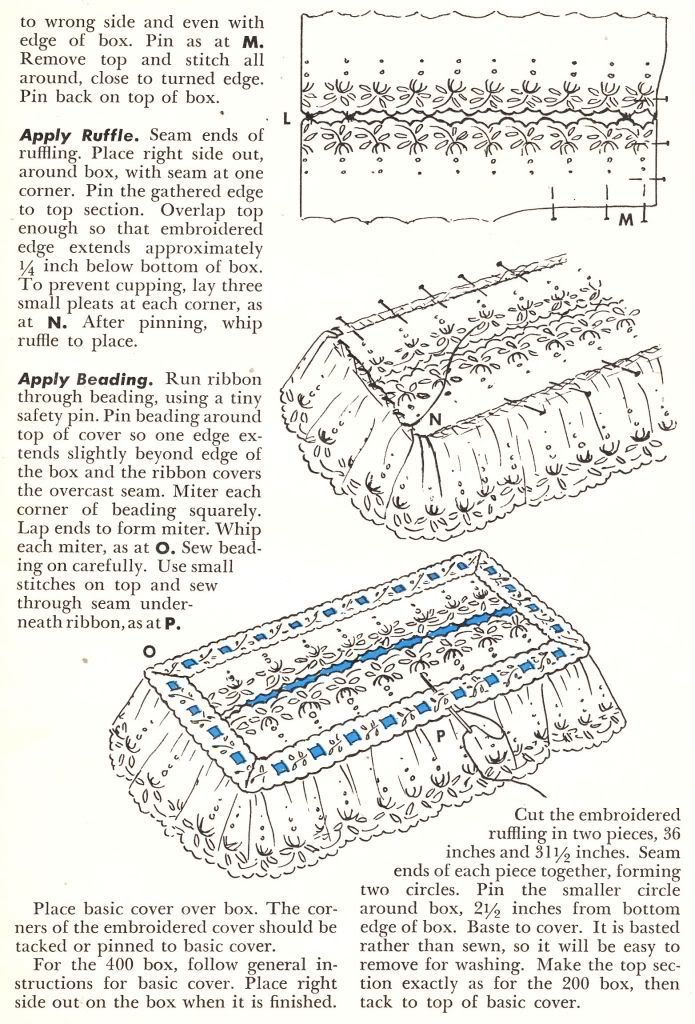
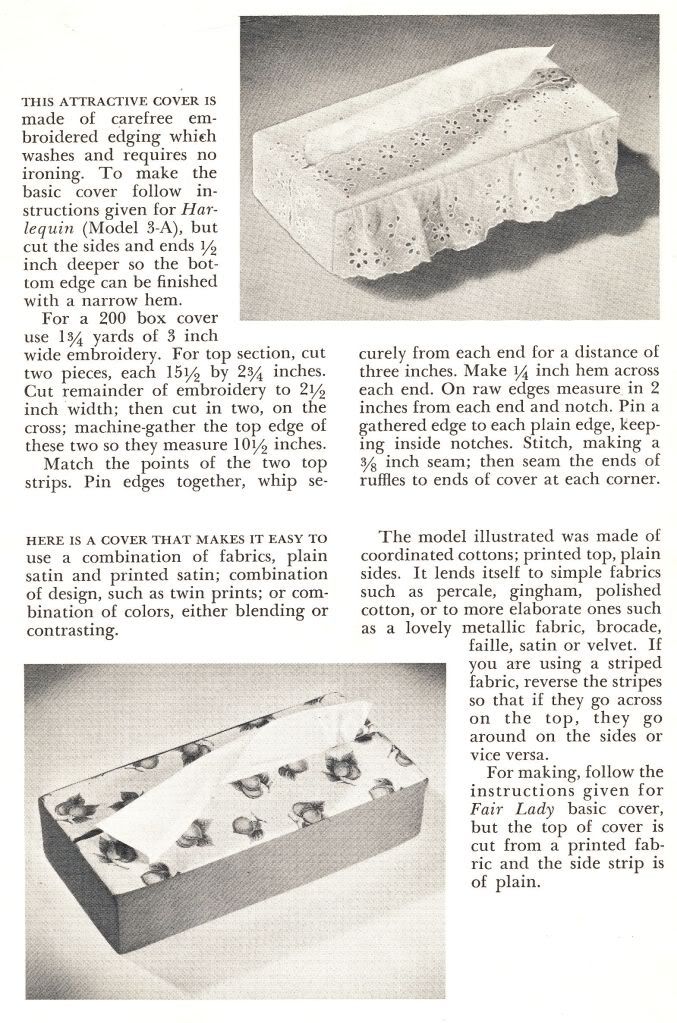
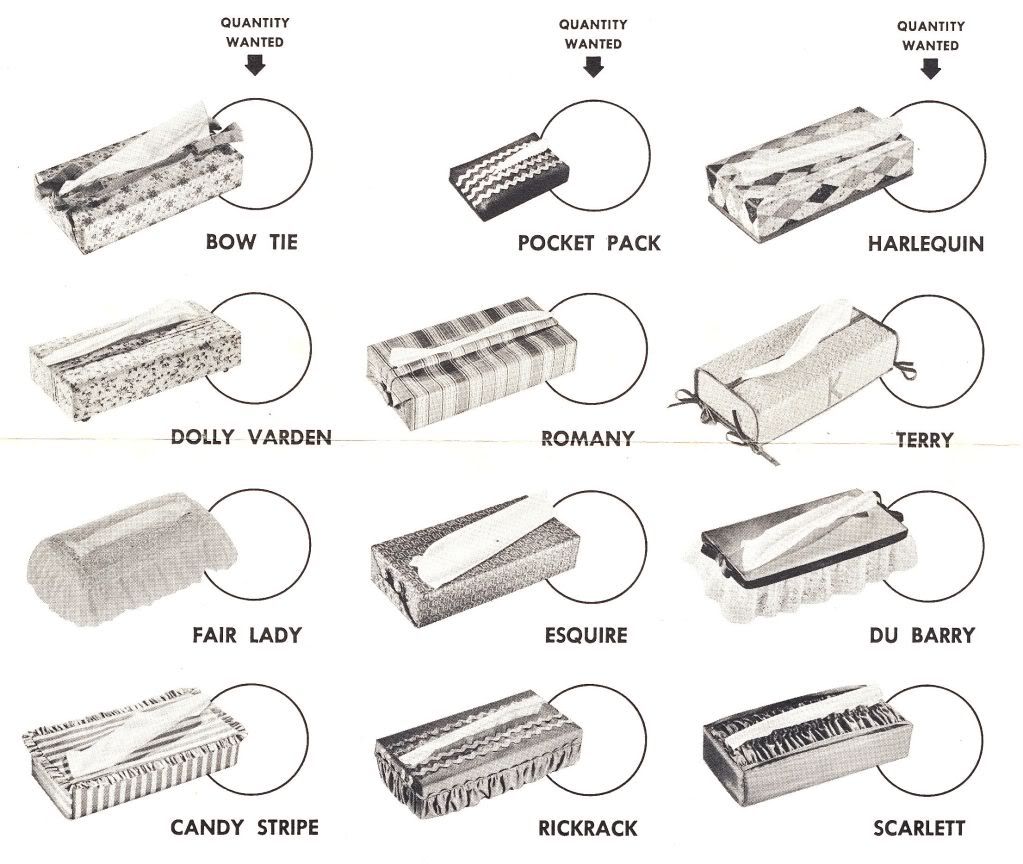
Shown here are the instructions for the "Fair Lady" and others are shown below. The intro is by Mary Brooks Picken - "Internationally known sewing authority" and she points out the "importance of blending or matching slip cover colors with Kleenex tissue colors."
Wednesday, April 21, 2010
The Woman's Institute - Laundering and Dry Cleaning - Part 7

"Following is a program that has proved its worth as a guide through the various steps of laundry work.
Monday:
1. Sort clothes.
2. Mend tears that will grow in washing.
3. Remove stains.
4. Soak soiled clothes.
5. Get equipment ready.
Tuesday:
1. Heat water.
2. Make soap solution.
3. Fill tub or washer and wash in succession (changing suds when necessary):
Table linen
Bed linen
Towels
Body linen
Handkerchiefs
Soaked clothes
4. Boil by putting clothes in cold water and letting them slowly come to boiling point.
5. Make starch.
6. Look over articles, especially if a washer has been used, to see whether further rubbing is necessary.
7. Rinse in 2 or 3 waters.
8. Blue, dipping and wringing each piece separately.
9. Starch clothes needing average stiffness, changing starch as often as necessary.
10. Hang out pieces.
11. Wash colored clothes, setting color, washing, rinsing 2 or 3 times, starching; and hang out to dry.
12. Wash cotton stockings, rinse, and hang to dry.
13. Take down clothes, piece by piece, fold and lay in the basket.
14. Dampen and roll up.
15. Wash any silk underwear, embroidery pieces, or colored clothes that must be ironed immediately, and iron. Also, wash flannels and wool or silk stockings.
Wednesday:
I . Do heavv starching.
2. Step No. 15, under Tuesday, may be left until now, if desired.
3. Iron.
4. Air.
5. Put away.
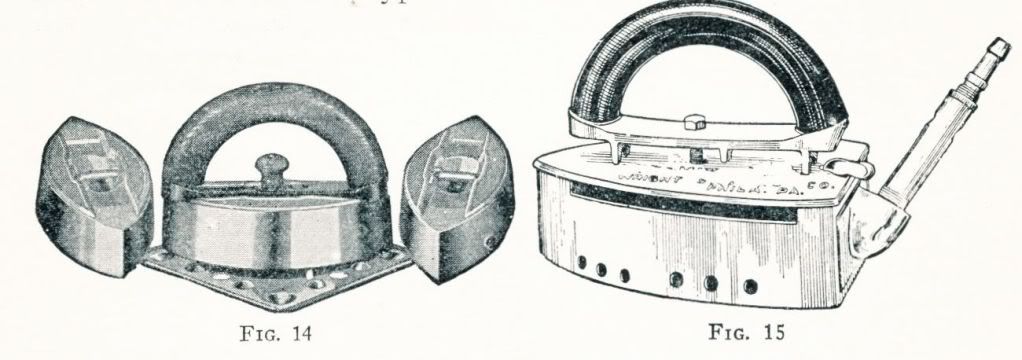
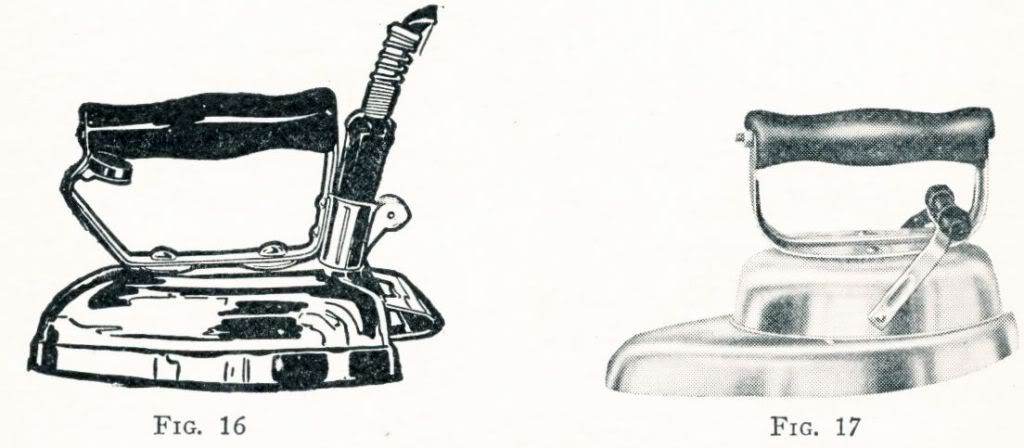
"Irons.-There are various types of irons; the old-fashioned, stove-heated flat, or sad, iron made entirely of iron, irons with removable wooden handles, also electric, gas, gasoline, charcoal, and alcohol irons. Although the old-fashioned, stove-heated iron can do its work efficiently, it cannot bring the comfort and ease to an ironer that a self-heating iron can. The woman who employs a self-heating iron does not have to consider saving steps, for instead of ironing near a hot stove or going back and forth to exchange a cold iron for a hot one, she can iron in one spot, and that a comfortable one. The type chosen, however, will depend on the facilities available for heatlng, but it is well to know the outstanding characteristic of each type."
"To protect large pieces, such as table-clothes from falling to the floor, a deep pocket of muslin may be attached to each side of the ironing sheet so that it extends from end to end of the board and within 6 or 8 inches of the floor, as in Fig. 13."
This next part comes under the Dry Cleaning portion of our book, I chose two tricky tasks that you might need to know about. Cleaning Kid Gloves and Feathers.
" Cleaning Kid Gloves - Kid gloves that are not seriously discolored or stained with perspiration may be easily cleaned by immersing in several gasoline baths, as for garment cleaning, but, if necessary, they may be handled more vigorously than fabrics."

"Fig. 11 shows the warm, gasoline, soap bath in which the gloves are first immersed. Allow them to remain in this bath a few hours to loosen the dirt; then rub between the hands and scrub with a stiff brush, as in Figs. 12 and 13, or rub on a small washboard."

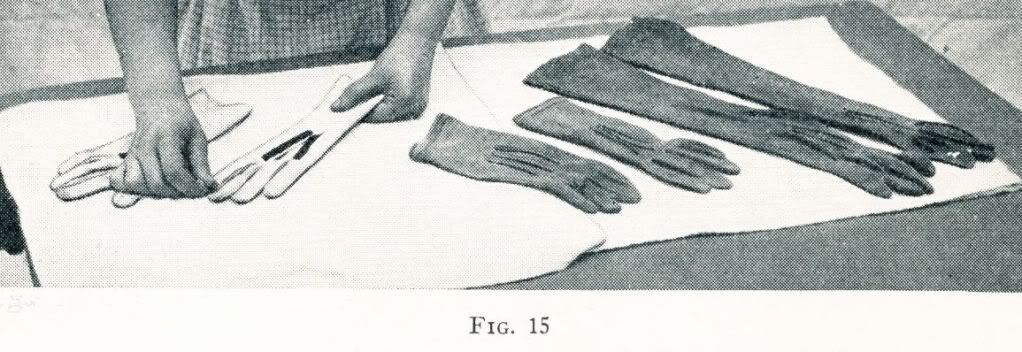
"Next, rinse thoroughly and wipe with a soft cloth. If necessary, dry further with Turkish towels, as in Fig. 14, and put on glove stretchers. Gloves should not be dried too rapidly, as this tends to make them stiff, but they may be dried as much as possible with towels and then laid in a warm place to finish drying. When thoroughly dry, shape them carefully and smooth them with the hands, as illustrated in Fig. 15."
Do you have your Gasoline, Wheat Flour and Corn Starch ready? Let's clean feathers!
"Cleaning White or Light-Colored Feathers - When cleaning feathers, aigrettes, and paradise plumes that are white or light in color, a large china or earthenware bowl, as shown in Fig. 16, should be used. Dry the bowl thoroughly, and pour into it a pint of clean gasoline. Wash the feather by sousing it up and down thoroughly.
It is generally unnecessary to rub the flues of the feathers, but if you do rub them, start at the point where the flues are joined to the stem of the feather and move the tips of the fingers outwards along the flues, pressing lightly. When the tips of the flues are reached, lift the hand and start again at the stem. Do not rub the flues back and forth, but move the fingers always in the same direction; that is, outwards from the stem to the tips of the flues.
Continue the operation until all of the flues on both sides of the stem are washed clean. Then pick up the feather and draw it through the lightly closed fist, in the manner shown in Fig. 16, in order to squeeze out most of the gasoline from the flues. Repeat this operation several times, until the greater part of the gasoline has been squeezed out."
"When the feather has been washed thoroughly in the manner just described, throw away the dirty gasoline used for washing it, and wipe the bowl clean and dry. Pour in a pint of fresh gasoline, and to it add 2 tablespoonfuls of wheat flour. Stir the flour into the gasoline until a smooth, thin paste is formed. Then stir the feather around or lay it in the paste and rub the flues lightly from the stem toward the ends with the tips of the fingers, in exactly the same manner as described for cleaning the feather the first time. When the feather has been washed completely in this way, draw it through the closed hand to squeeze out the gasoline, and shake it in the air until the remaining gasoline has evaporated and the feather is almost dry, a process that will require from 2 to 5 minutes.
When the feather is practically dry, it must be rolled in clean corn starch. To do this, spread a piece of tissue paper flat on the table and sprinkle it lightly but evenly with corn starch. Roll the feather back and forth in the corn starch by twisting the stem until it is well covered. Then shake the feather to remove the loose particles of starch adhering to the flues, and the cleaning process is finished.
The advantage of this method of cleaning is that it will not take the curl out of the feather, as in the case of soap and water, but it must be remembered that this process is for cleaning white and light colored feathers only."
Tuesday, April 20, 2010
The Woman's Institute - Home Sewing - Part 6

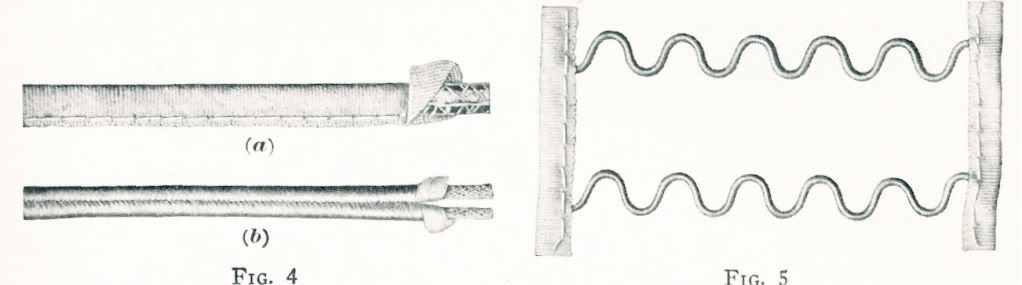
"Boning and Stays for Collars - usually consist of narrow widths of covered featherbone in both black and white. In Fig. 4 are shown two varieties, that in (a) being covered with silk ribbon and the one in (b), with floss. Besides collar featherbone, which is sold by the yard, there are celluloid collar stays and, as shown in Fig. 5, covered wire ones called serpentine. These are made 2 to 3 inches in length and are usually covered with silk or cotton thread. They may be purchased on cards having six collar stays on each card, or the serpentine variety, attached to a binding, as here shown, may be purchased by the yard."
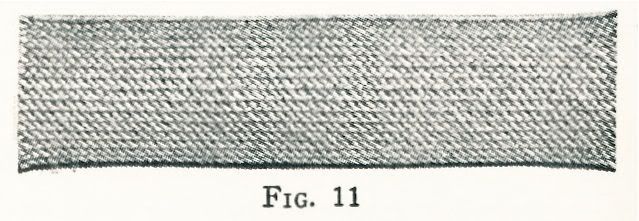
"Skirt Braid, shown in Fig. 11, is a smooth, evenly woven, twilled braid that is made in only 3/4 inch width. It is used to protect the bottom of skirts from hard wear when they are long and full. Braid of this kind may be obtained in mercerized cotton or wool in all standard colors, and is sold usually by the 3-yard pIece or the bolt."
"Cabochon Foundations-In the making of bunch bouquets and various other ornaments, whether of ribbon or other materials, cabochon foundations, as shown in Fig. 17, will be found useful. Cabochon foundations are merely small pieces of buckram pressed into a dome or similar shape, here shown, those in (a) being white buckram and those in (b), black. In (a), the cabochon shown at a and b have not had their edges cut, while those at c, d, c, and f have been trimmed."
"Coat Weights, one of which is shown in Fig. 25, are round, oval, and oblong, and they vary in size from No. 1 to No. 4, the largest being about the size of a half dollar. Such devices are used to give weight to the lower edge of coats, to panels in coats, and to parts of woolen dresses."
"Shot-Weight Tape, shown in Fig. 26 (a), consists of closely woven cotton material in which small shot is held. It is used in the bottom of tunics, the ends of sashes, etc., in order to make them hang correctly."
"Flat-Weight Tape, shown in Fig. 26 (b), is used where more weight is desired than the shot-weight tape provides."
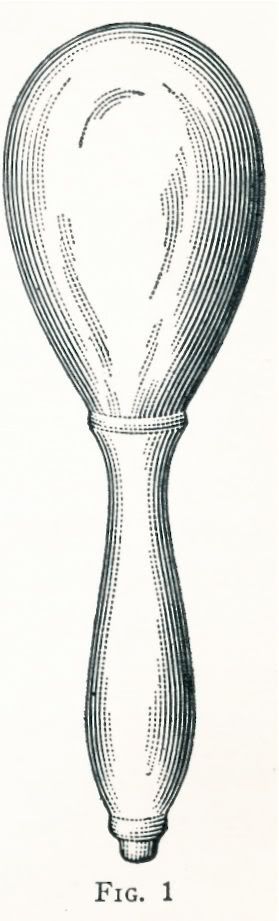
And for you youngesters this is a Darning Egg (or Darner or Darning Ball)
And this what you do with it...
Monday, April 19, 2010
The Woman's Institute - Sewing For Profit - Part 5

"As has been pointed out, a woman possessing a knowledge of sewing and garment construction may follow any one of several ways in putting that knowledge into practical use; and it is always well for her to be governed in what she decides to do by her preference for the kinds of work that will be required of her, as well as by her ability to do them, for she will make the greatest success of the work that she likes best and that she can do best. Likewise, it will be well for her to remember that if the field for work along the lines she prefers is not large enough, she should arrange to include other things in order to keep herself and, if possible, her helpers busy."
"Use of the Measure Slip-One practice that a dressmaker should never fail to follow when the customer comes to plan a dress, is to take her measurements. As it is very important that these be complete in every respect, a measure slip, such as the one shown in Fig. 6, should be used. It will be observed that this slip is arranged so as to give all the necessary information in a concise and systematic manner."


Sunday, April 18, 2010
The Woman's Institute - Children's and Maternity Garments - Part 4

"An attractive short negligee, generally known as a bed jacket, is shown in Fig. 4. It consists merely of a rectangular section of material cut according to the diagram at the upper left and having all its edges bound with a harmonizing color. As such a garment does not receive hard wear and as a dainty effect is desirable, the light colors, such as flesh, pink, blue, orchid, and yellow, are preferred. Any of these, bound with a lighter or a darker shade or with a color that combines well with it, such as orchid with pink or yellow, would be most effective. Tiny flowers, made of narrow ribbon or heavy embroidery floss in pastel colorings, provide a dainty trim around the neck and on the sleeves, while two-tone ribbon forms ties at the front neck and the under arms."
"Proper-fitting, adjustable brassieres are an actual necessity for the prospective mother. These may be of various types, depending on the figure, and the adjustment may be in the front or back, as preferred. In Fig. 1, views (a) and (b) show brassieres suitable for the large, full figure, view (a), made entirely of a figured sateen, being the type that closes in the back with waist-Iine ties fastened in the front, and view (b), the front opening type fastened with hooks along the side-front seam and made further adjustable by inserts of elastic webbing. Such a brassiere becomes useful as a nursing type after the baby's birth."
I looked and looked at this illustration and finally figured that the "great convenience" for the mother was the use of ties that "certain authorities" recommended and this illustration was the layers that you set out for one change of clothing, "each one fastened securely without turning the baby once".

"Certain authorities, interested in baby welfare and advocating simplicity of cut in garments, recommend opening them their entire front or back length, but front preferably, and fastening them with tape rather than buttons and buttonholes, as shown in Fig. 37. Such a plan proves a great convenience to the mother, for the garments can be arranged in their right order, one on top of the other, as shown here, the baby then slipped into them with great ease, and each one fastened securely, without turning the baby once. The chief essential, in using such a layette, is to see that each article is arranged smoothly with shoulder lines together so that, when the tapes are tied, there will be no wrinkles to smooth out.
Patterns for layettes of this kind can be procured, so, if you are interested in using garments that will require very little handling of the baby in putting them on and taking them off, it is well to make such a layette. Of course, it will be necessary for you to sacrifice your desire for attractive little dresses and slips, as such a plan necessitates plainer, more substantial garments, and a full-length opening naturally prevents the dainty trimming effects that make baby clothes so pretty."
This includes photos and complete instructions to make most of the items shown, after all you were expected to become an accomplished seamstress using these books. But this next drawing with some of the accompanying photos show how much detail went into garments, even for a childs underwear!

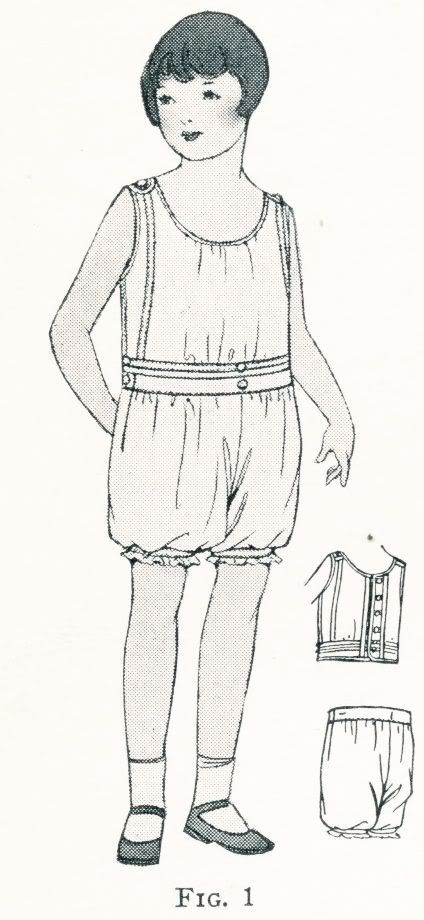
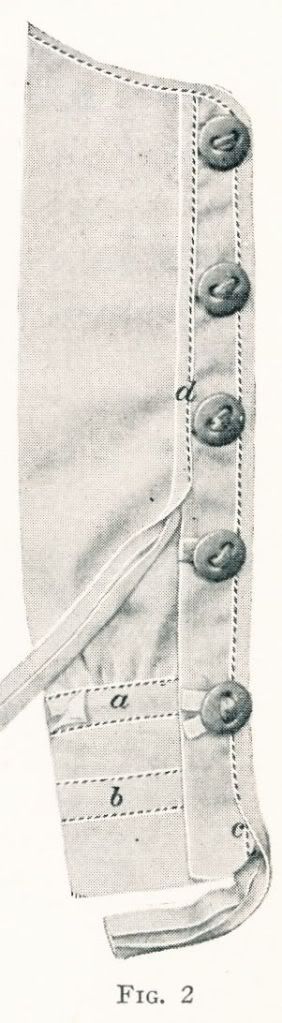
"Some mothers consider it practical to buv underwaists ready-made, and when time is a very important itern they are fully justified in this idea, for the amount of labor that is involved in their development should be a important consideration for busy mothers.
From the standpoint of actual cost, however, the making of underwaists involves a saving. Then, too, the quality of material used may be of the best and the labor may be reduced to a minimum if sewing-machine attachments are employed and the style illustrated in Fig. 1 is followed."

This bit about Blouses for boys explains exactly how much embroidery you may add "to very good effect", but don't get carried away and don't add any after the age of 6!"

"Blouse for boys are of two general types; the overblouse of the jumper, middy, and Russian-blouse type, and the tuck-in blouse. Both of these types are worn interchangeably with the same trousers, making greater variety possible.
Overblouses, with the exception of middies, are suited only to boys of 6 years or less. Middies may be worn by boys up to 12 years or even older, with either long or short trousers. Tuck-in blouses, being more in the nature of shirts, are suitable to boys of all ages. Sometimes in suits for boys of from 2 to 4 years, they are sewed to the trousers at waist line, making a one-piece suit in two-piece effect.
A great many variations in cut and trimming are possible within the narrow limits of these two types of blouses, so that the mother who is alert to individual touches may have them in plenty on her little son's suits. Though embroidery is considered feminine, it is possible to use small amounts of it to very good effect on the blouses of small boys, if carried out in conventionalized designs with simple stitches. Finely plaited frills and tiny jabots are not objectionable on very small boys, nor are tucks and stitched-in plaits in the fronts of blouses. When a boy passes his sixth year, however, the more tailored and masculine his clothes are, the better he will like them, and the more suitably dressed he will appear."
Saturday, April 17, 2010
The Woman's Institute - Cutting And Fitting - Part 3

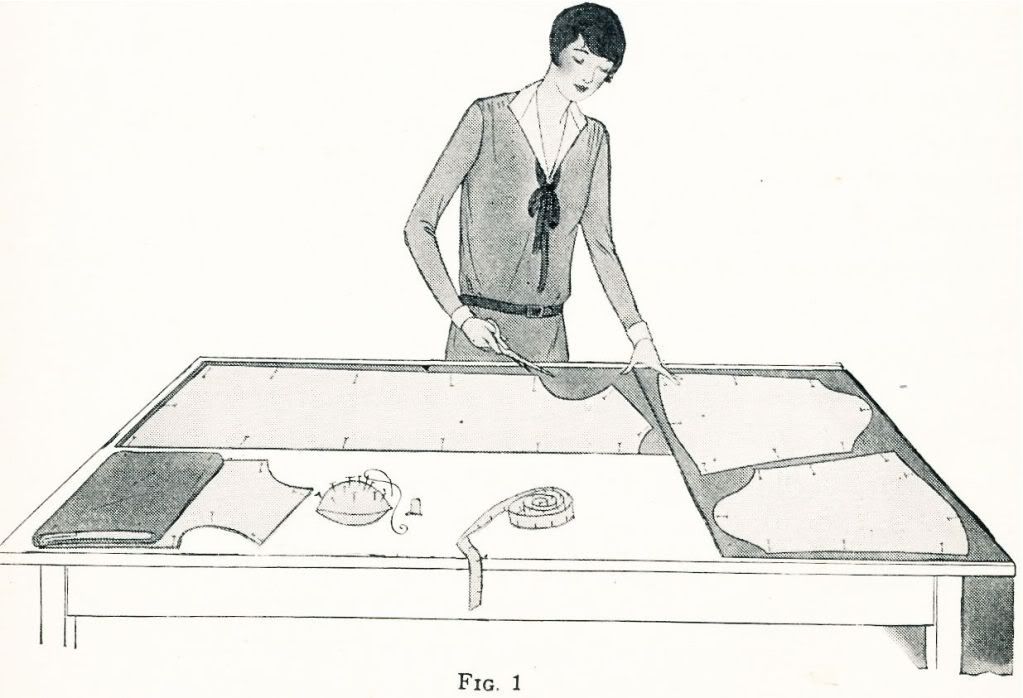
"To spread out the material on which to arrange the pattern pieces before cutting, it is necessary to have a large smooth, flat surface. This should be a table, a good type being shown in Fig. 1. A bed, which is sometimes used, is not satisfactory as it does not have a firm surface and so makes accurate cutting difficult. If you do not have access to a large table, a large piece of wall board, which can be laid on the bed when needed and stored in a closet when not in use, will help to solve your problem."
" The slip shown in Fig. 14 illustrates the type of foundation that is often necessary for the coat dress that opens at the side front. A section of the material of the dress is added so that the skirt, in swinging open, does not show a contrasting rnaterial. The shape and width of this section will depend on the cut of the dress to be worn over the slip. Also, a vestee is attached, a feature that is often necessary in both coat and other types of dresses. Two lengthwise darts in the back give an opportunity to fit the slip as snugly as desired. Either the built-up or camisole may be used."
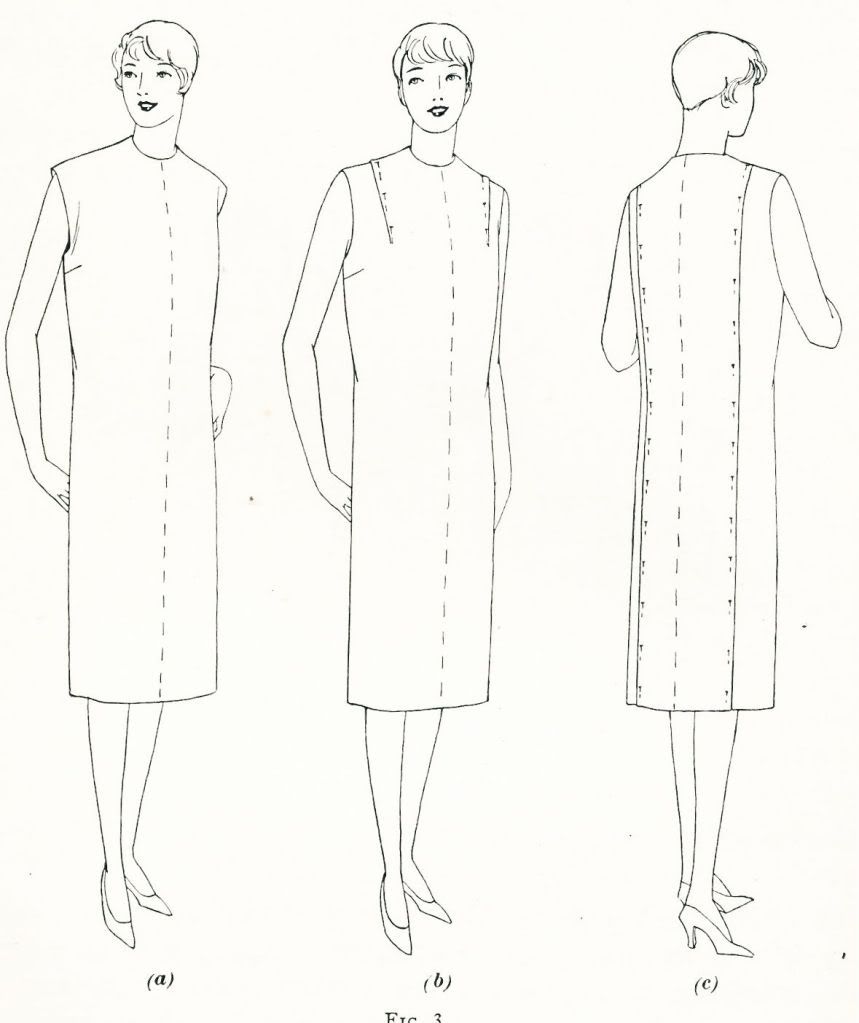
" Shoulder of Garment Too Wide.-In making patterns for the larger sizes, the width of the shoulder is sometimes increased in proportion to the size of the bust. However, in the figure itself the size of the shoulder, which is a bony structure, does not often increase in proportion to the increased measurement of the bust, which is a tissue structure. So it often happens that a pattern, purchased by bust measurement, provides a shoulder that is too wide, as shown in Fig. 3, view (a). The same defect occurs in smaller sizes when the shoulders of the figure are unusually narrow. Or, if the material used is one that stretches on the cross grain, such as some of the knitted fabrics, a similar problem often arises."
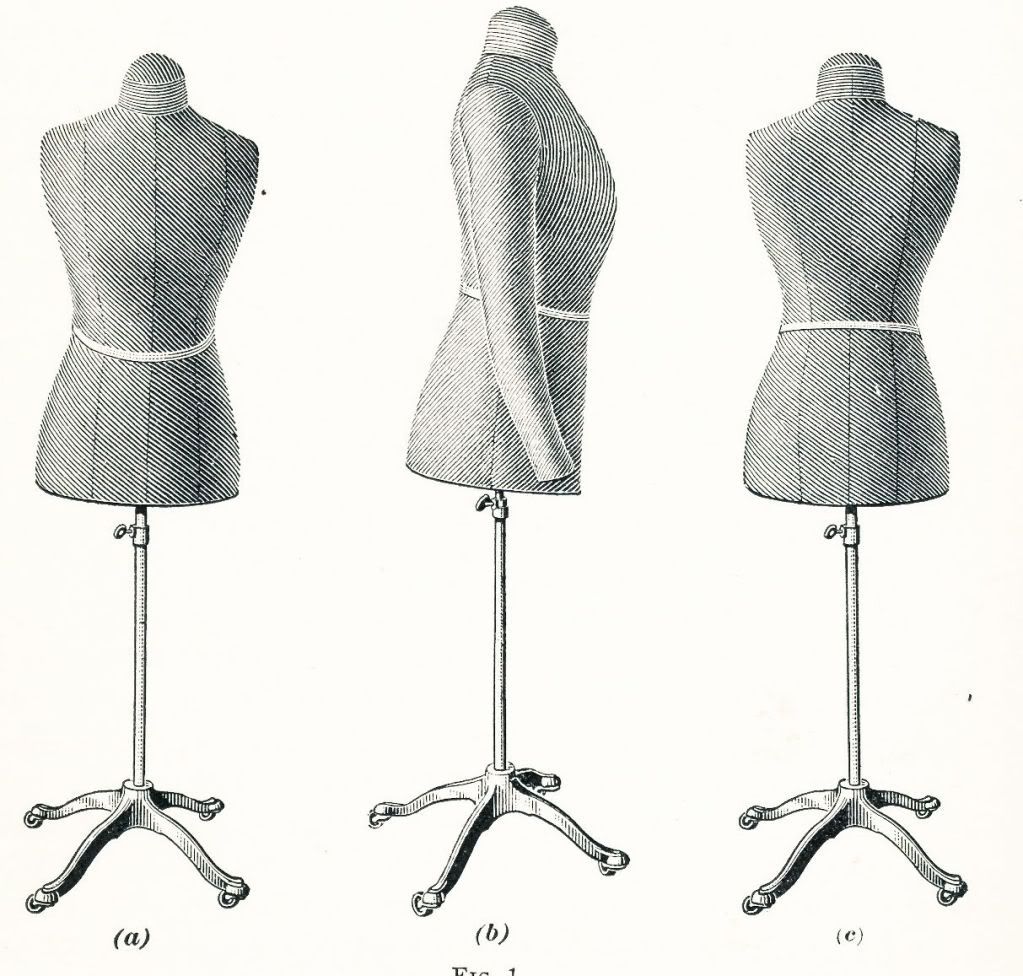
"Because of variations in the measurements of different persons, it is rarely possible to obtain a solid form duplicating exactly the individual figure. The best plan, therefore, is to procure a form seemingly smaller than is required and increase it to individual measurements by the use of a padding of cotton batting and a tight lining. A dress form that has been padded is shown in Fig. 1 view (a) showing the front view, (b) the side with arm attached, and view (c), the back.
To prepare such a form, first make a tight lining that exactly fits the figure. Then pad the form and apply the lining and the arms."
Friday, April 16, 2010
The Woman's Institute - Designing And Decorating Clothes - Part 2

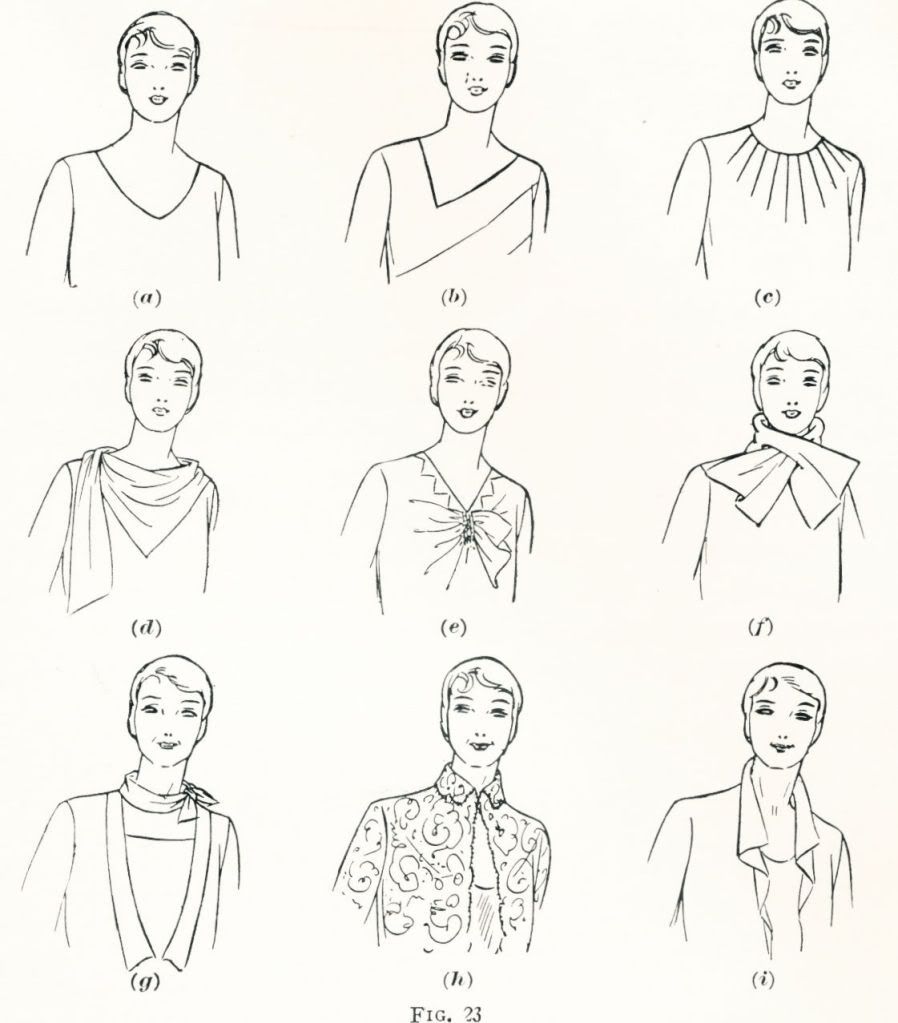
"The ideal, or average, figure that has an attractive, well-proportioned oval face with regular features, can wear almost anv neck line that pleases her. However, even slight irregularities of feature, the length and fulness of the throat, and the way in which the hair is worn, all have a bearing on the manner in which the neck line of the dress may be shaped and finished. It is, therefore, necessary to study all these points so as to design becoming necklines, for the neck line frames the face and greatly affects the apparent size and contour. In designing, however, it is important to work for harmony between the neck finish and the rest of the design. various neck lines that can be worn by the average figure, or by other figures whose face, neck, and shoulders are approximately average, are shown in Fig. 23."
"Dress and Wrap Designs.-The most desirable effect to gain is one of grace and softness, rather than severely tailored ones, but because it is very easy to cross the line into fussiness when striving for such effects, it is essential that the designing be carefully done, for smartness must never be sacrificed. Among certain types of tall, slender women, there is a tendency to affect the picturesque in dress, and while such a plan is sometimes feasible when a woman may have a great many clothes, it is safer to keep away from this sort of clothes, except for such special occasions as call for them."
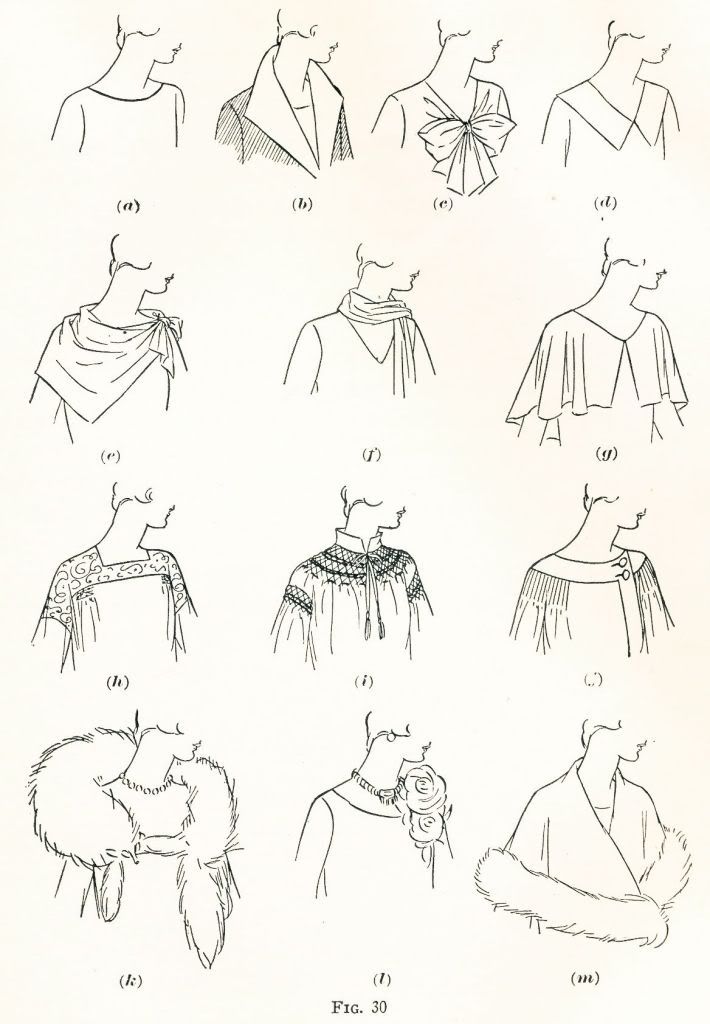
"Neck and Shoulder Treatments.-The tall slender figure is usually thin in the neck and shoulders, but there are all sorts of designing features that may be employed, as Fig. 30 shows, to overcome such defects. Sometimes these pertain to the neck alone and again are so developed as to embrace the shoulders. And frequently, accessories may be called upon to lend their help in creating the illusion of greater bulk."
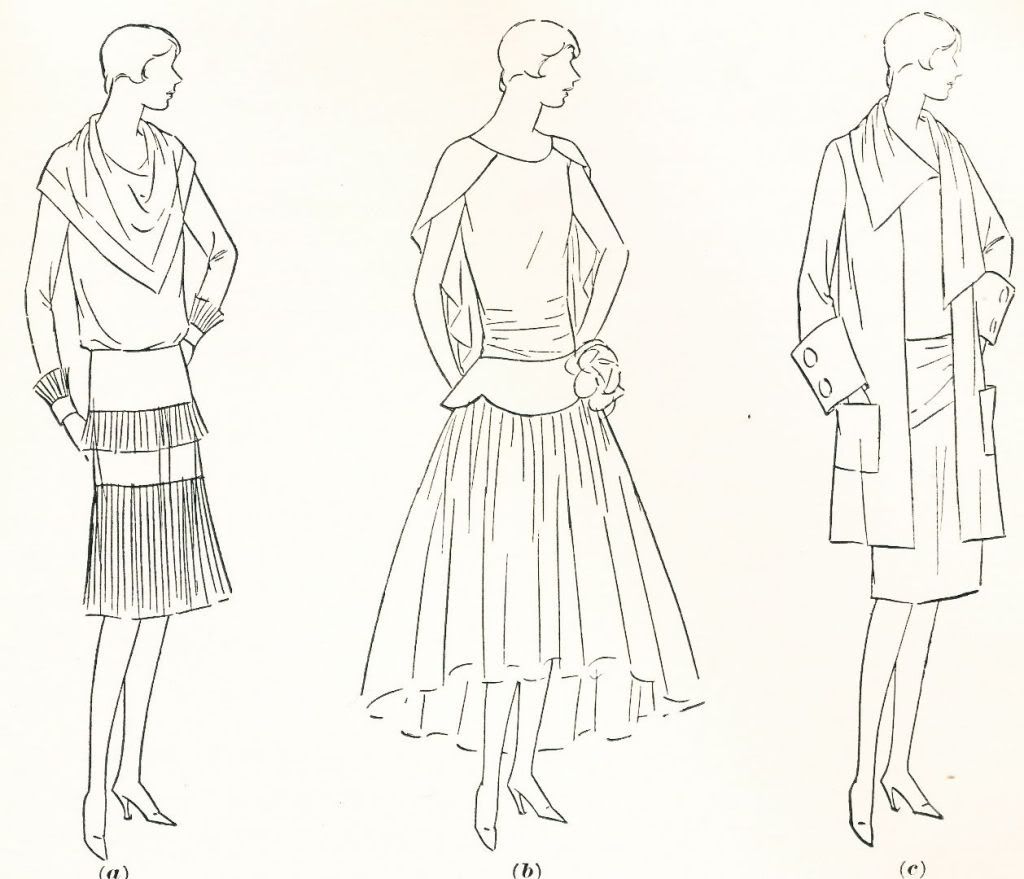
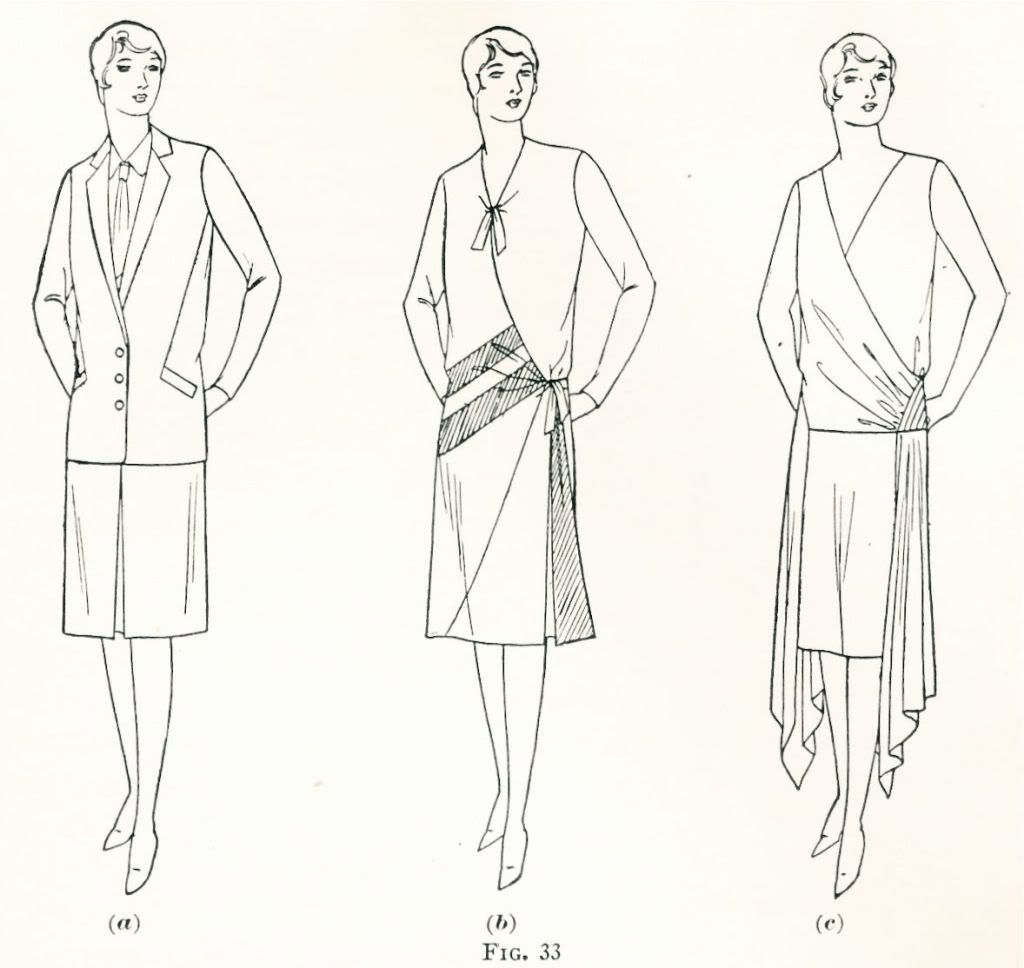
"Dress Designs.-Smartness for this type ties largely in tailored simplicity, in restrained decoration, and in richness of effect. Ruffles, excessive flares, or features that suggest fussiness must be shunned, while at the same time lengthening lines must not be overemphasized because of her height. A tailored, an afternoon, and an evening costume suitable for this figure are given."
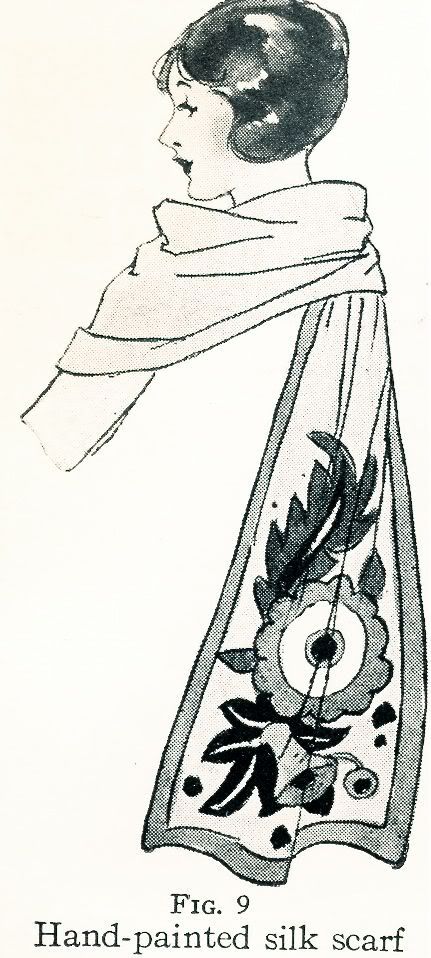
"Painted Designs-Painting designs on fabric to beautify it was, a very early form of decoration. It was probably first employed by primitive civilizations while weaving was still in a crude state, but its use has persisted throughout the entire history of textiles. Painted or stenciled designs on fabrics have not, until recently, been permanent and so could not be so strongly recommended, though the beautiful silk ball gown worn by Martha Washington, and now preserved in the Smithsonian Institution, was painted all over
with a charming flower design, and some of the lovely scarfs imported from France and Russia, a copy of one of which is shown in Fig. 9, are painted with great success in vigorous forms and strong colors in the manner of the futurist art. With the recent developments in paints and dyes, however, the art of fabric painting has been so improved that beautiful and lasting effects can now be obtained."
Thursday, April 15, 2010
The Woman's Institute - First Steps In Dressmaking - 1927
I will show a few images and words of wisdom from each of these volumes. This is the first installment.

" To dress well is an art that is acquired chiefly by study. The ability to recognize the small, important things in dress, the patience to exercise care in details, with an appreciative eye for effect, and the ambition to forge ahead by constant thought and application are qualities worthy of cultivation. So long as figures, fashions, fabrics, and individual needs change, just so long will it be necessary to study the art and essentials of dress.
Any woman who is dressed inappropriately or in ill-fitting, badly made clothes loses a great part of her charm; and this fact alone is sufficient reason why no woman should ever allow herself to appear at a disadvantage. Well-fitting, well-made garments of the cheaper materials appropriate for the occasion or the need look far better than ill-fitting, poorly made garments of expensive fabrics."
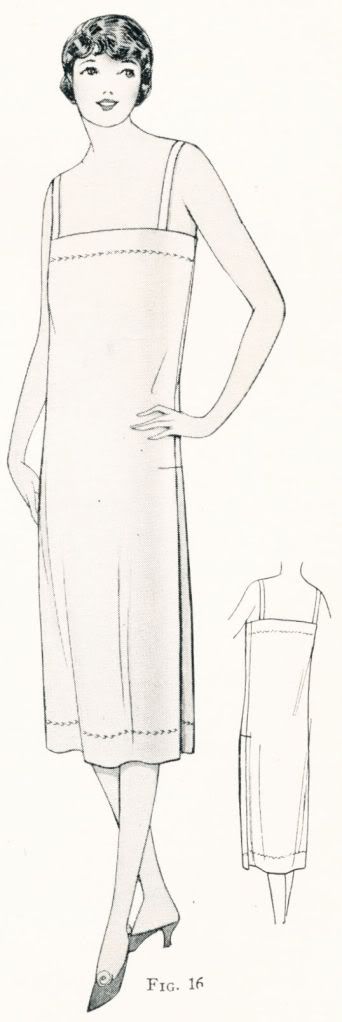
"The costume slip fills a very important place in the wardrobe, covering, as it does, the need for both petticoat and corset cover. It is simple to make and to wear, may be developed from a minimum of material, and is easv to launder. It may be trimmed as elaborately or as simply as one desires.
The slip shown in Fig. 16, is one of the simplest of these garments as regards both cut and trimming, since it is cut without a pattern and uses only feather-stitching for decoration."
" If, in marking a skirt or slip for yourself, there is no one at hand to aid in marking the length, you may use a yardstick, as shown in Fig. 21 (b), or any straight stick, and mark the length yourself with tailor's chalk.
Stand the stick upright on the floor with one end touching your figure, and make a mark on the skirt at the point on the stick that is in line with your hip line. Then move the stick around the figure, placing marks or pins a few inches apart at this same point. By tying a string around the yardstick at the point at which the chalk marks are made, you will be able to locate it readily when working at the back of the skirt. While the slip is still on the figure, turn the lower edge at the center front to decide on the length. Then remove, and measuring down the same distance from each mark, place pins.
Next, replace the pins along the lower edge with basting, adjusting, the lower edge if it seems uneven. Lay the slip on the table or over the end of a sewing machine or ironing board, and complete the hem"
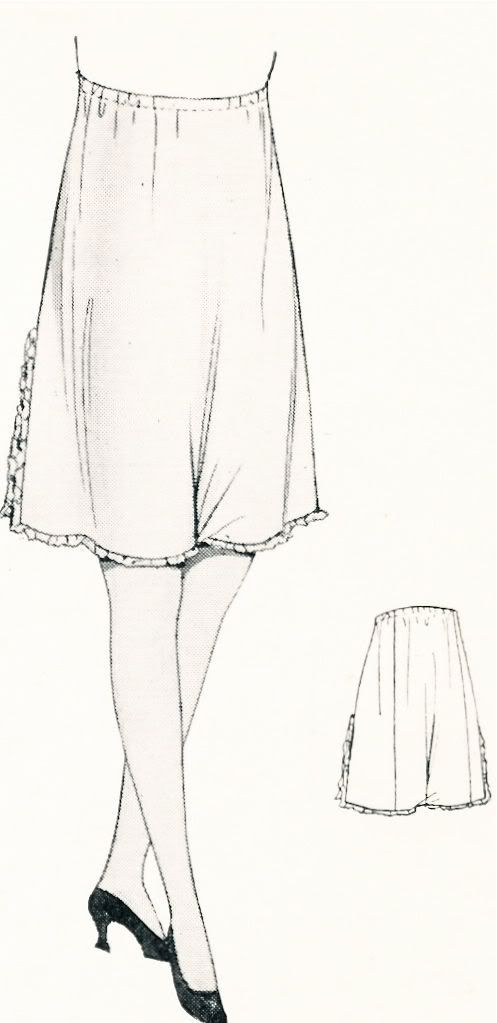
" Becatise they eliminate the need for an extra pair of straps over the shoulders, short step-ins, such as are illustrated in Fig. 22, have become very popular, particularly for wear with the costume slip. Because they are dainty, easily laundered, and not bunglesome to wear, many women prefer them to bloomers and all other forms of drawers." 
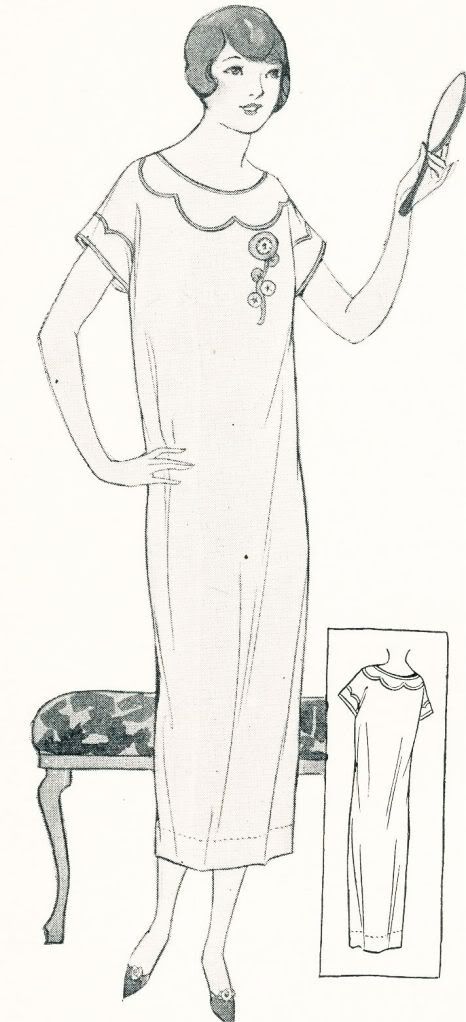
" A nightgown that has the advantages of rapidity of cutting, case of making and distinction of style, is shown in Fig. 23. Its trimming effect, gained by the use of bias binding in harmonizing colors, gives a definite appeal and, because it is so easily applied, adds very little to the time necessary for making the nightgown."
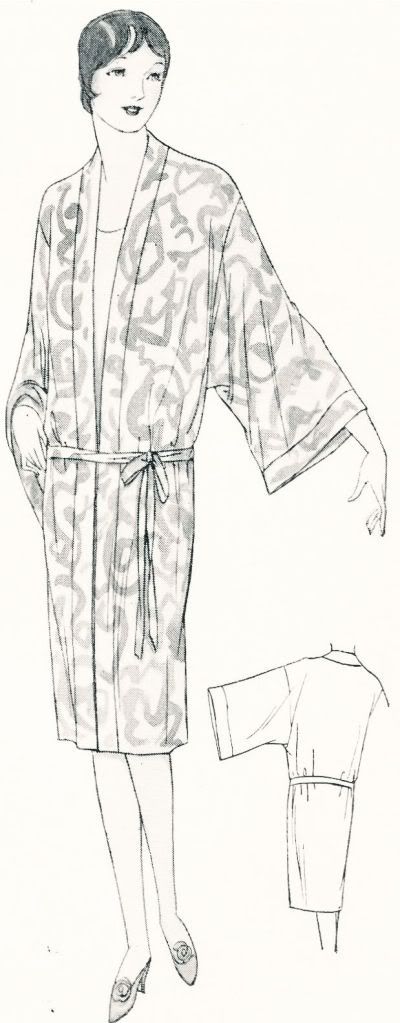
" Simplicity of construction is one of the commendable features of the very attractive drop-shoulder kimono shown in Fig. 27. A without the use of a pattern and in a very short time, you can make a duplicate of this garment which will both fill a real need and provide you with a charming negligee."