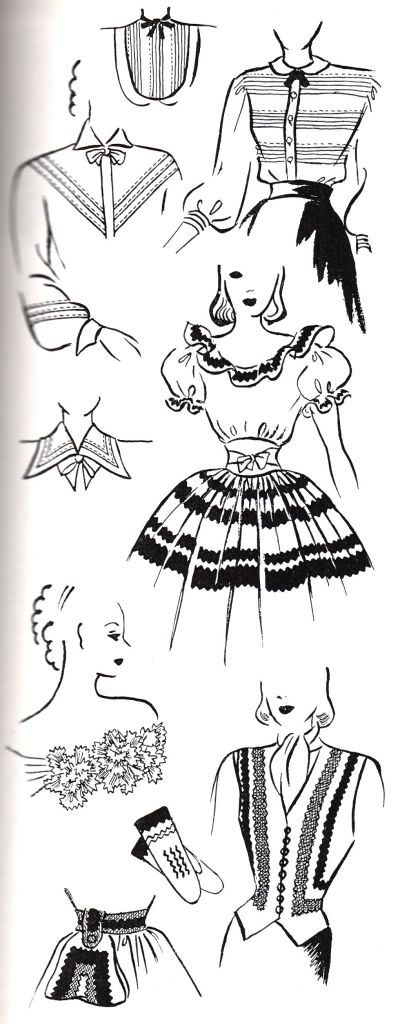
Tucking and Pinking. Every one of the Singer fashion aids offers its own distinctive method of enhancing garments and accessories. On this page are shown ways for using the Tucker and the Pinker. The trim tailored lines of tucks in the blouse fronts at the top can be made in lengthwise, crosswise, or diagonal patterns, as shown, and evenly spaced, graduated or in groups. Tucking is one form of fabric decoration that is nearly always in fashion. It is attractive not only in sheer cottons and lingerie fabrics, but also in dress woolens. For tucking in children's and infants' garments. The Pinker makes the easy and attractive notched edges shown in the rosettes at the neckline and in the trimming of vest, gloves, belt and bag at the bottom. Felt is excellent for pinked bandings, since it does not ravel. Taffeta, chintz, organdie, and plastic fabrics are also practical for pinking. The dress in the center also shows the versatility of the Pinker. The applied pinked bands in neck ruffle and skirt are of two different widths and so spaced as to make an interesting crosswise accent.
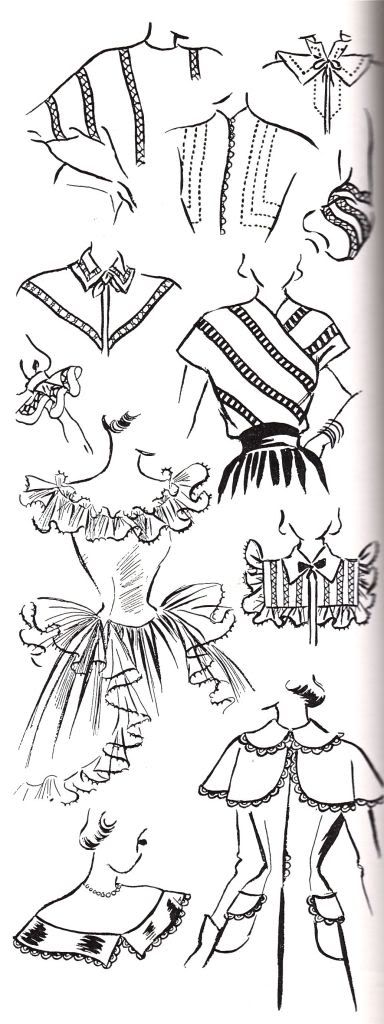
Fagoting and Hemstitching fabric decoration with open-work designs and with self-trimming can provide attractive fashion details. Open work is particularly appropriate for summer clothing and lightweight fabrics, while the tubing is suitable for somewhat heavier fabrics. Both the Singer Fagoter and the Hemstitcher can be used for open-work lines. The choice depends on the effect desired. The Hemstitcher gives a narrow line of open work and does this in stitching directly on the fabric. The collar and bodice front at the top right show bow hemstitched designs appear. The Fagoter makes an open-work insertion which is applied in seams or in slashes placed to contribute to the dress design. The lines in the deep armhole and shoulder at top left, the deep ruffled cuff at the left and the ruffled yoke at center are done with the Fagoter in cross-stitch effect. Use yarn, braid, tubing, crochet cotton or embroidery floss to make your fagoting, depending on the fabric used in the garment. The Hemstitcher has another very practical and effective use. It provides the dainty edge finish of the picoted ruffles in the sheer dress at center right and the yoke beside it. This is produced when hemstitched lines are cut in half. Tubing Self-trimming with tubing can be used in a variety of ways. It, too, can provide open-seam insets, as in the diagonal lines of the blouse and the neckline shown here. The tubing, made with the Cording Foot is cut and stitched in parallel lines to give the ladder pattern of the blouse and inserted. A contrasting color used here accents this line. This arrangement may be varied by knotting each cross bar. As an edge finish, tubing is also attractive when arranged with the looped or scalloped line shown on the off-the-shoulder neckline and the cape coat below.
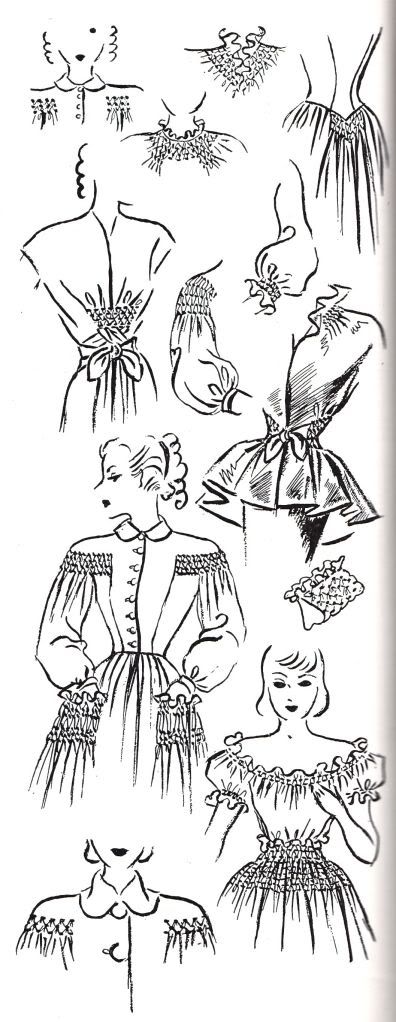
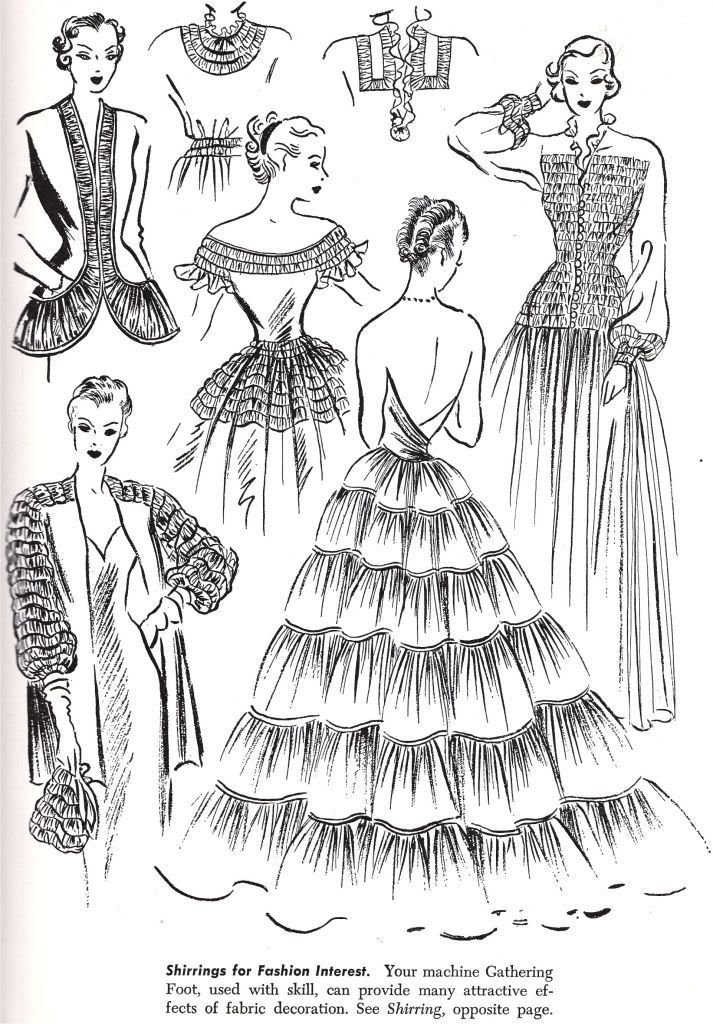
Fullness with Smocking. Always a favored fabric decoration for children's clothes and young effects, machine smocking is also attractive on grown-up garments and accessories where it is desirable to hold and control fullness at shoulder, neckline, waistline, etc. 'Peasant" styles can be created by using bright colored thread for the stitching. More formal effects, as at the upper right of the illustration, require stitching with matching thread. Smocking, either by hand or with your machine Gathering Foot, should be done only in fabrics that are soft enough to look well with considerable fullness. Many like to gather by machine, then decorate with a twisted chain or briar-stitch by hand over the machine gathering lines. This is especially attractive in plisse' cotton crepe, for children's dresses, blouses and skirts.
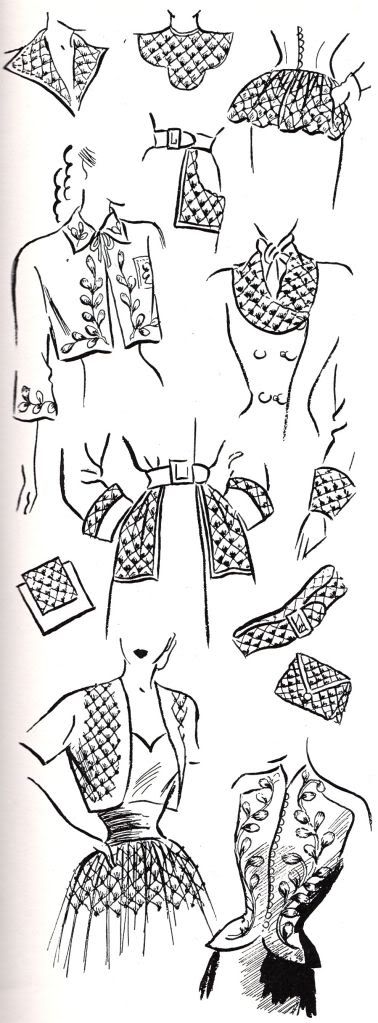
Quilting- Top-Stitching Quilting. Originally used to provide warmth, quilting is now more often used for enrichment or beautification of fabric and for purpose of design. When fashion favors quilting for wearing apparel and when you are master of your machine, the Quilter, with its adjustable Quilter Bar, can help you to make really lovely garments and accessories (see page 118). A few designs are shown here to inspire you to use this very practical means of fabric decoration. Simple block quilting, as shown on pockets, collars, cuffs, and belt here, can be very effective. For evening wear, it may be given added interest by adding sequins at the crossing of stitching lines, as in the bolero jacket and gathered skirt. Italian quilting in floral designs, as in the two other jackets shown here, especially dainty and feminine.
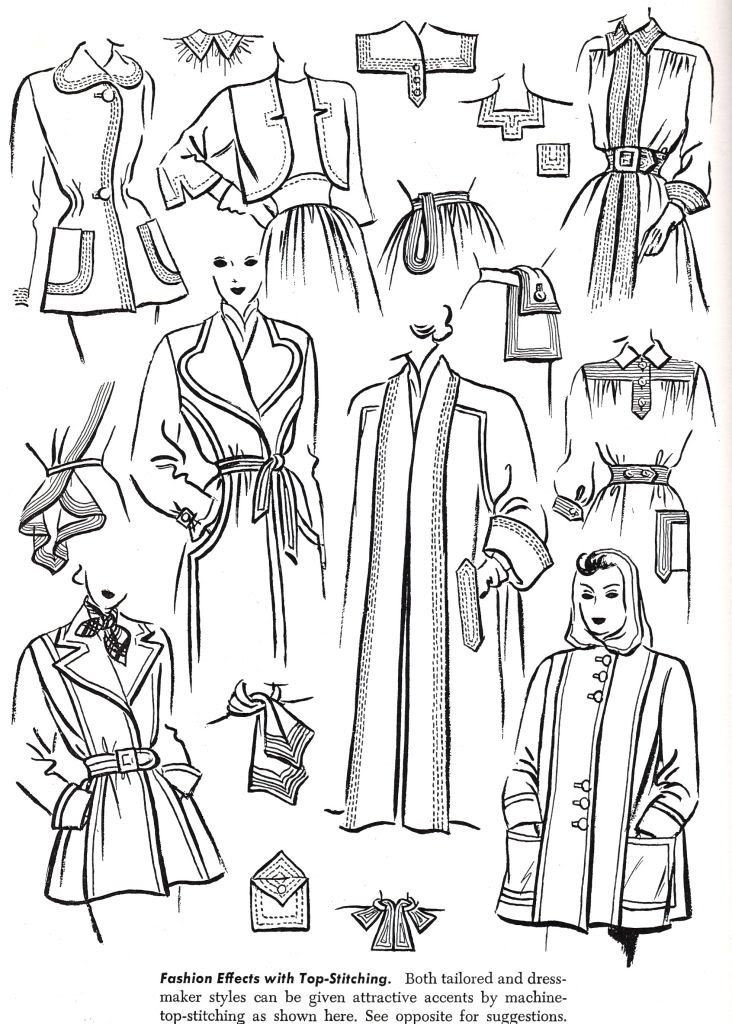
Top-Stitching. This is a smart and practical way to accent the lines of a garment and to give additional firmness along edge. Stitching may be done in matching or contrasting thread, according to the effect desired. A single line of stitching on heavy fabric, as in the coats at the bottom of the opposite illustration, gives a welted effect. In lighter weight fabrics, several parallel rows can be used, either in all-over effect, as in cuffs, yokes, pockets, belts and panels, or to lend importance to a line or edge.
Designers' Sketches the fashion sketches here and on the following page show how designers use the decorative finishes. Fashion is selective. One season banding or braiding is favored, the next may bring shirrings, gatherings, puffings, or flounces. These illustrations are given to stir your imagination and show the variety of possibilities in such decorations. Experienced buyers realize that the difference in price ranges of ready-made garments depends less on the cost of fabric than on the good workmanship of the better clothing. The more expensive the dress, the more certain you are to find details such as these in its construction.

Bands and Edges Edge-Stitcher. Wherever straight smooth edges and narrow inconspicuous joinings are required, the Edge-Stitcher proves its worth. Net, lace and filmy fabrics which are to be stitched together in bands or in all-over effects, such as the blouse at, top-center, are beautifully handled by the Edge-Stitcher. This attachment is also valuable for giving a crisp edge to perky ruffles, as around the neckline at bottom, and when bands of fabric, ribbon or braid are used, as in the skirt and the sleeve shown. For very fine work, use matching thread, a short stitch, and tissue paper underneath for protection.
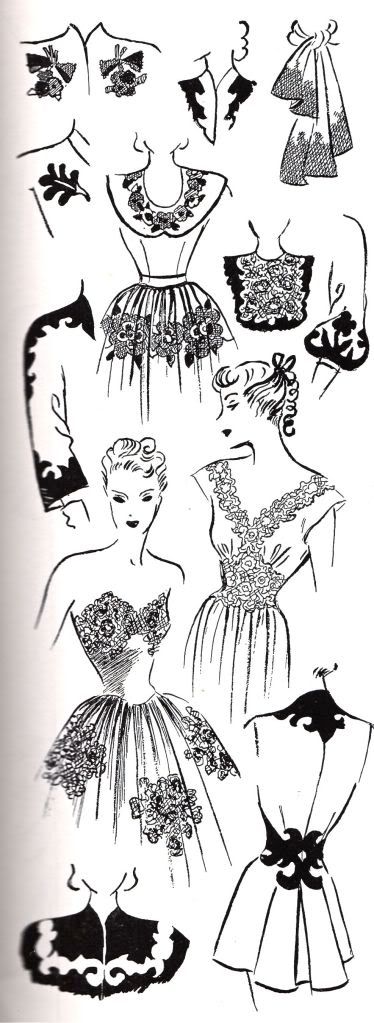
The Zigzagger for Applique. Of all the practical Fashion Aids which the sewing machine provides, none contributes more to the beauty of both design and fabric than does the Zigzagger. With it, you can applique the most intricate, time-taking designs, doing the work even more effectively and with far less handling than by hand. This page shows you only a few of the ways in which it can serve you. The zigzag stitching line it makes back and forth across the joining is ideal for applying the shaped edges of lace to filmy fabric, as in lingerie and evening wear. For applying fabric motifs, it also makes an excellent secure and inconspicuous edge finish. Flower motifs, conventional designs, monograms may all be applied in this easy way. The particular advantage of applique is that it lends interest through contrast-contrast of textures, of color, and of design. The tracery of the outline against a plain surface is eye-catching. Velvet on broadcloth, taffeta on satin, satin or taffeta on organdie, taffeta on satin or net, net or lace on chiffon, plain cotton on printed, or plain silk on printed-these are only a few of the possible combination's you can use. On sheer fabrics, self applique gives the shadowy contrast of a double thickness. If you are not expert with the Zigzagger, go to a Singer Shop and learn how to use it for applique.

Feminine Frills Ruffles. Feminine as a powder puff, ruffles are the essence of daintiness. The infinite, variety of ways to use ruffles is just hinted in the illustrations opposite. With your machine Ruffler and Gathering Foot you can make these perfectly and with a minimum of effort. Center-stitched ruffles, applied on a curved line, are used in the round-necked blouse at the top and the evening dress at the bottom, tiered ruffles in the petticoat showing beneath the lifted skirt. The blouse front at top left has a ruffle inserted in a seam. The all-over ruffled effect in the jacket just below is obtained by applying center-stitched ruffles along parallel lines marked in the fabric. Ruffles generally are best cut on a true bias, hemmed, picoted, or lace-trimmed, then plaited or gathered. They may, however, be made of ribbon, of lace, of a bias fold. Always press your ruffle after the edge is finished and before gathering the top. Keep ruffling in a box-do not let it get wrinkled after it has been gathered.
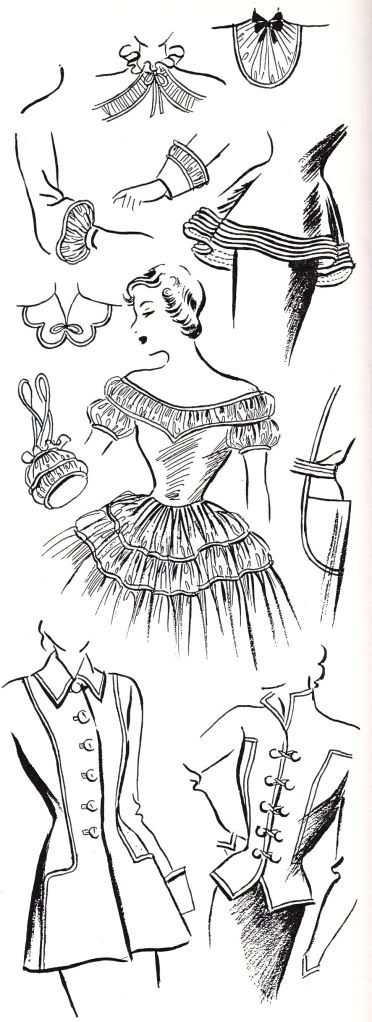
Corded Finishes Cording. The illustrations here give you an idea of the many ways in which your machine Cording Foot can help you in achieving attractive and professional-looking details. Cording may be made of self-material or in contrasting color, depending on whether a color accent is desired or not. When inserted in seam lines, cording gives weight and importance to the lines of the garment. It also makes an attractive edge finish for collars, necklines, cuffs and jackets, as shown. Several additional rows of cording may be put in above the edge to give the effect shown in the flared tunic illustrated. Where a shirred section joins plain fabric, as in the blouse front at the top, cording may be inserted to give the joining a nice finish. The center dress and the bag show how corded shirring holds and distributes fullness, and the shirred bands at the top illustrate the use of cording to give a firm neat finish at the edges of the bands.

Trimming with Braid Braiding. The sketches opposite show a few designs for braid trimming. Make your own motifs, choose a transfer pattern, or take a rubbing from a pattern and transfer this to your fabric for the braiding lines. Learn to use both the Braiding Foot and the Underbraider expertly before beginning such work. Then braiding can give you a decorative touch at neckline or pocket. It can accent the lines of a long-torso dress or a short bolero. Braid can add distinction to a simply cut evening wrap and give a note of interest to a plain bodice or the lapels or peplum of a dressmaker suit.