Showing posts with label Smocking. Show all posts

Wednesday, May 9, 2012

The Simpler Stitches of Smocking

Have you tried smocking? I like how it doesn't take very much to make a huge impact. It's beautiful on a christening gown, charming on a child's dress and perfect on a peasant blouse. Try it!


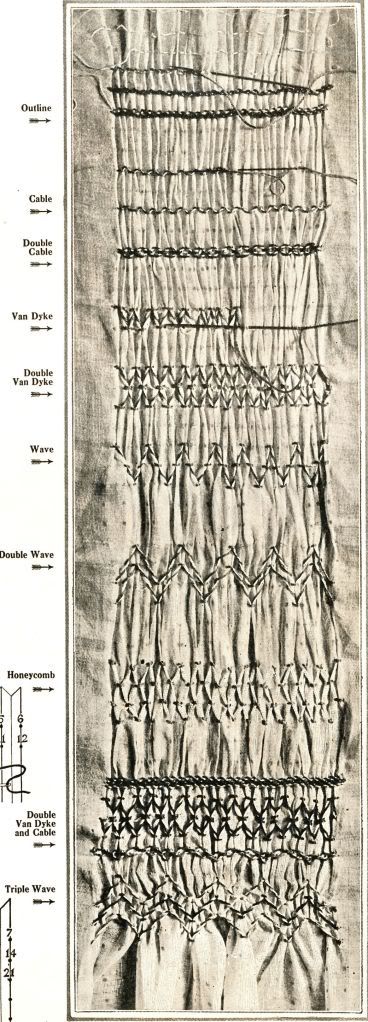
In the early days when a peasant's blouse was not a fitted garment and there were sections that required gathering, in order to make them fit, smocking as a means of gathering the excess fabric came into being, and many were the variations that were introduced. Many of the simpler stitches are illustrated here.
The best aid in smocking is the row upon row of carefully and evenly placed dots, obtained most easily by using a stamping pattern. Usually two and a half times the width of the material (when finished) is required before stamping. You can he assured of more even and beautiful smocking if the gathering is done before the smocking is begun, and the width desired when finished determined and regulated by the gathering threads.
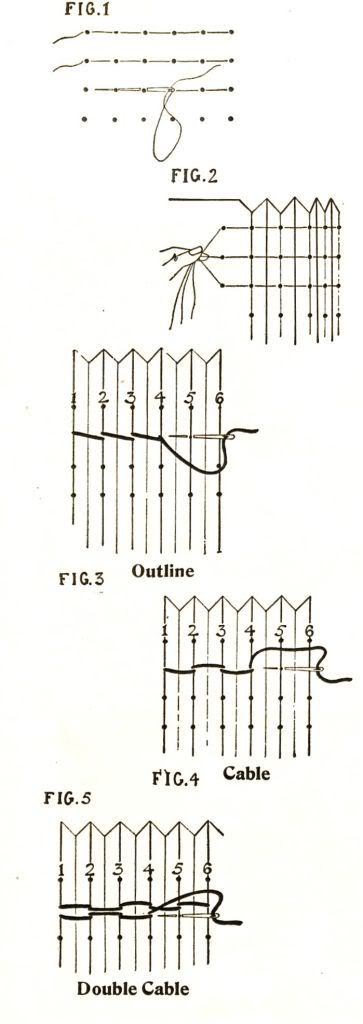
Fig. 1 shows the method of gathering the dots under the needle, and Fig. 2 shows how the material when gathered makes the plaits along the row of dots, which enables you to quickly take up the three or four threads of the fabric. Compress your materials into plaits so that the width of the plaited material is the width you wish for the finished smocking.

Outline Stitch (Illustration No. 3)
The outline stitch is worked on one line of horizontal dots. Begin at the left. Bring the needle up between dots 1 and 2. Pick up dot No. 1, keeping the thread below the needle. Pick tip dot No. 2 and draw slightly together. Continue by taking up dot No. 3, drawing together, then take dot No. 4 and continue, always keeping the thread below the needle.

Cable Stitch (Illustration No. 4)
The cable stitch is worked in the same manner as the outline stitch except that the thread in the first stitch is held under the needle and in the second stitch the thread is above the needle. The third is under the needle and the fourth above, continuing in alternating stitches.

Double Cable Stitch (Illustration No. 5)
The double cable stitch can be worked on one row of dots, keeping the second row of stitches close to the first row, using the same row of dots. If the top or first row is begun with a stitch with the thread held under the needle, the second row of stitches is begun with the thread held over the needle, alternating to the end.

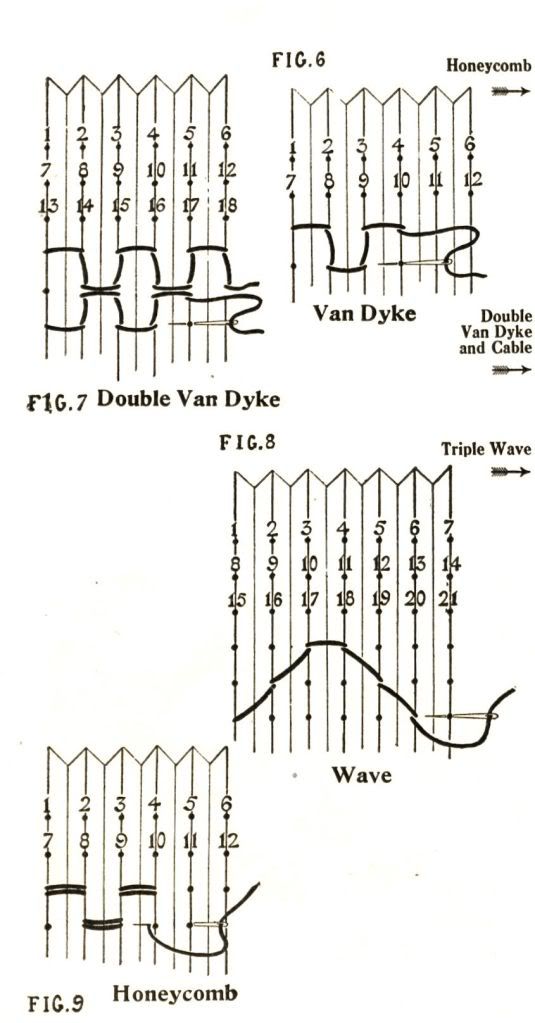
Van Dyke Stitch (Illustration No. 6)
Starting at the left, bring needle up to the right of dot No. 1, take a stitch with the thread above the needle, through dot or plait No. 1. With the thread above the needle, take stitch through dot No. 2 from right to left. With the thread still above the needle, take stitch through dot No. 9. With the thread below the needle, take stitch through dot No. 10. With the thread below the needle, take stitch through dot No. 3. With the thread above the needle, take stitch through dot No. 4. Repeat until end.

Double Van Dyke (Illustration No. 7)
The first row is made the same as the single Van Dyke. The second row begins at dot No. 13, taking a stitch with the thread below the needle. With the thread still below the needle, it goes to dot No. 14. With the thread below the needle, to No. 8. With the thread above the needle, to No. 9, keeping the stitch under the previous row. With the thread above the needle, to No. 15 . With the thread below the needle, to No. 16, and with the thread below the needle, to No. 10, and with the thread above the needle, to No. 11.

Wave Stitch (Illustration No. 8)
Beginning at the left, bring the needle tip to the right of dot No. 15. Take a stitch through dot No. 13 with the thread under the needle. With the thread under the needle, take a stitch through dot No. 9. With the thread under the needle, take a stitch through dot No. 3. With the thread over the needle, take a stitch through dot No. 4. With the thread over the needle, take a stitch through dot No. 12, and with the thread over the needle, to dot No. 20. With the thread under the needle, continue to dot 21. If any of the dots are visible after smocking, remove with gasoline.

Honeycomb Stitch (Illustration No. 9)
Bring thread up through dot No. 1. Stitch No. 1 and 2 together with the thread over the needle. Draw needle through dot No. 2 again, and out through No. 8. Draw 8 and 9 together with thread tinder the needle. Bring through dot No. 9 up to 3, and stitch 3 and 4 together with the thread above the needle. Repeat.

Saturday, November 7, 2009

Singer Sewing Book - Using your Machine Attachments - 1951 (Part 2)


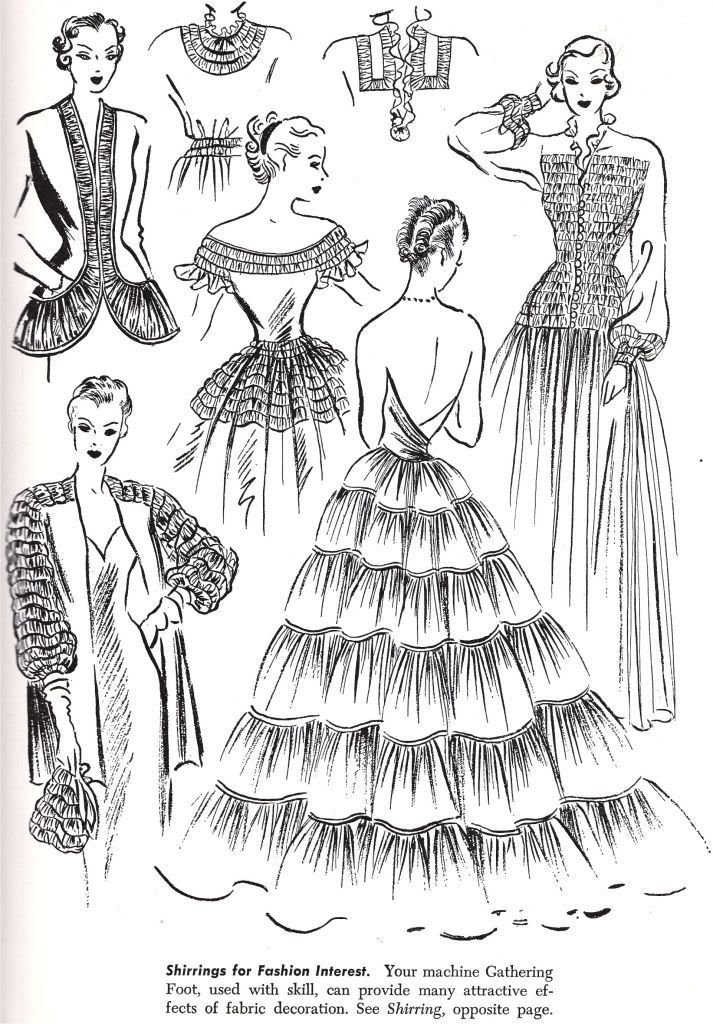
Fullness with Shirring. Shirring consists of two or more rows of gathers and gives soft, rich effects. When fashion approves shirrings, your machine Gathering Foot comes into its own. Use matching thread, space rows evenly and distribute fullness equally along stitching line. The illustration here shows several ways in which fashion makes use of shirrings. Inserted shirred bands are shown in the blouse front opposite. A corded shaped band of shirring makes an interesting border treatment for the jacket at the top left. All-over shirred effects, as in the bodice and in the full coat sleeves shown, are obtained by evenly spaced rows of gathers put in before the garment sections are assembled. The generous skirt of the evening dress is not actually shirred, but is made of row after row of deep ruffling, joined with cording. Remember that shirring is always best in soft, limp fabrics, and that the allowance for making must be ample, since the gathers require l 1/2 to 2 times the finished measurement. Do not plan group shirrings for garments that must be washed often, since ironing is difficult.


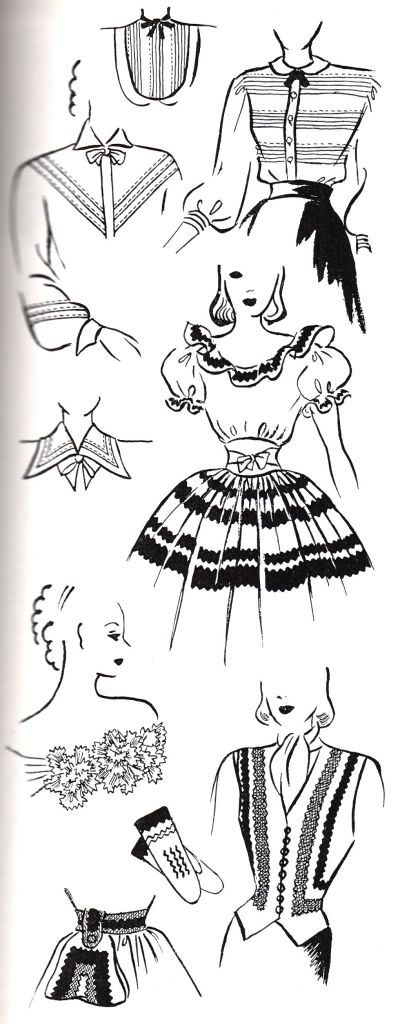
Tucking and Pinking. Every one of the Singer fashion aids offers its own distinctive method of enhancing garments and accessories. On this page are shown ways for using the Tucker and the Pinker. The trim tailored lines of tucks in the blouse fronts at the top can be made in lengthwise, crosswise, or diagonal patterns, as shown, and evenly spaced, graduated or in groups. Tucking is one form of fabric decoration that is nearly always in fashion. It is attractive not only in sheer cottons and lingerie fabrics, but also in dress woolens. For tucking in children's and infants' garments. The Pinker makes the easy and attractive notched edges shown in the rosettes at the neckline and in the trimming of vest, gloves, belt and bag at the bottom. Felt is excellent for pinked bandings, since it does not ravel. Taffeta, chintz, organdie, and plastic fabrics are also practical for pinking. The dress in the center also shows the versatility of the Pinker. The applied pinked bands in neck ruffle and skirt are of two different widths and so spaced as to make an interesting crosswise accent.


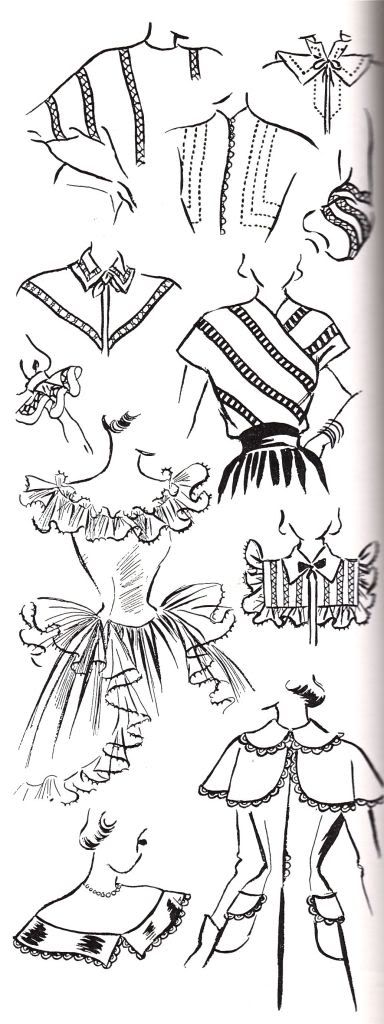
Fagoting and Hemstitching fabric decoration with open-work designs and with self-trimming can provide attractive fashion details. Open work is particularly appropriate for summer clothing and lightweight fabrics, while the tubing is suitable for somewhat heavier fabrics. Both the Singer Fagoter and the Hemstitcher can be used for open-work lines. The choice depends on the effect desired. The Hemstitcher gives a narrow line of open work and does this in stitching directly on the fabric. The collar and bodice front at the top right show bow hemstitched designs appear. The Fagoter makes an open-work insertion which is applied in seams or in slashes placed to contribute to the dress design. The lines in the deep armhole and shoulder at top left, the deep ruffled cuff at the left and the ruffled yoke at center are done with the Fagoter in cross-stitch effect. Use yarn, braid, tubing, crochet cotton or embroidery floss to make your fagoting, depending on the fabric used in the garment. The Hemstitcher has another very practical and effective use. It provides the dainty edge finish of the picoted ruffles in the sheer dress at center right and the yoke beside it. This is produced when hemstitched lines are cut in half. Tubing Self-trimming with tubing can be used in a variety of ways. It, too, can provide open-seam insets, as in the diagonal lines of the blouse and the neckline shown here. The tubing, made with the Cording Foot is cut and stitched in parallel lines to give the ladder pattern of the blouse and inserted. A contrasting color used here accents this line. This arrangement may be varied by knotting each cross bar. As an edge finish, tubing is also attractive when arranged with the looped or scalloped line shown on the off-the-shoulder neckline and the cape coat below.


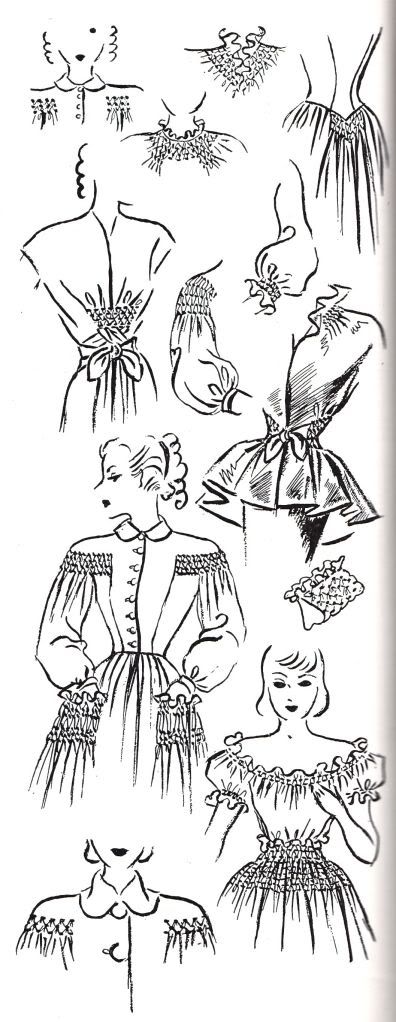
Fullness with Smocking. Always a favored fabric decoration for children's clothes and young effects, machine smocking is also attractive on grown-up garments and accessories where it is desirable to hold and control fullness at shoulder, neckline, waistline, etc. 'Peasant" styles can be created by using bright colored thread for the stitching. More formal effects, as at the upper right of the illustration, require stitching with matching thread. Smocking, either by hand or with your machine Gathering Foot, should be done only in fabrics that are soft enough to look well with considerable fullness. Many like to gather by machine, then decorate with a twisted chain or briar-stitch by hand over the machine gathering lines. This is especially attractive in plisse' cotton crepe, for children's dresses, blouses and skirts.


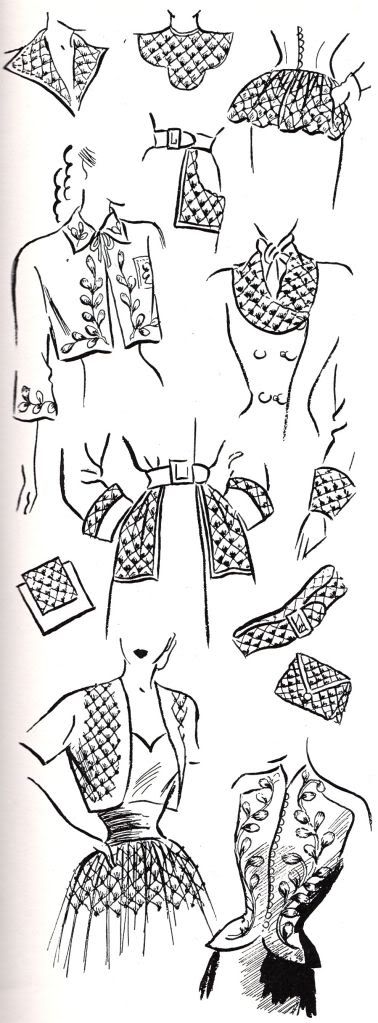
Quilting- Top-Stitching Quilting. Originally used to provide warmth, quilting is now more often used for enrichment or beautification of fabric and for purpose of design. When fashion favors quilting for wearing apparel and when you are master of your machine, the Quilter, with its adjustable Quilter Bar, can help you to make really lovely garments and accessories (see page 118). A few designs are shown here to inspire you to use this very practical means of fabric decoration. Simple block quilting, as shown on pockets, collars, cuffs, and belt here, can be very effective. For evening wear, it may be given added interest by adding sequins at the crossing of stitching lines, as in the bolero jacket and gathered skirt. Italian quilting in floral designs, as in the two other jackets shown here, especially dainty and feminine.


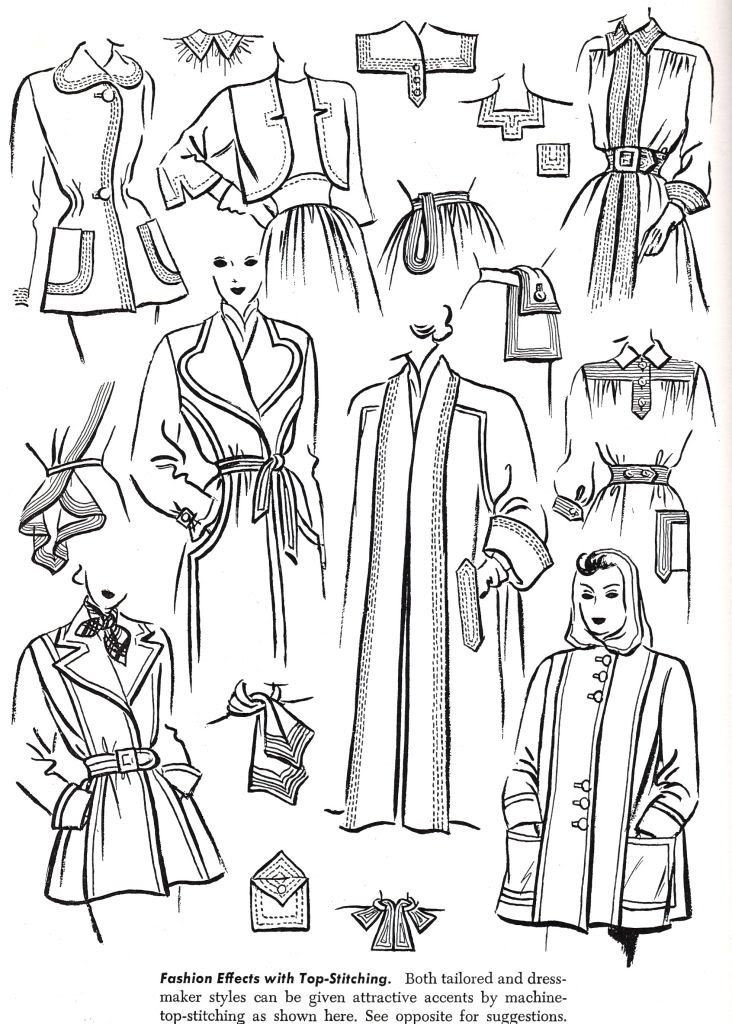
Top-Stitching. This is a smart and practical way to accent the lines of a garment and to give additional firmness along edge. Stitching may be done in matching or contrasting thread, according to the effect desired. A single line of stitching on heavy fabric, as in the coats at the bottom of the opposite illustration, gives a welted effect. In lighter weight fabrics, several parallel rows can be used, either in all-over effect, as in cuffs, yokes, pockets, belts and panels, or to lend importance to a line or edge.