Showing posts with label 1930. Show all posts

Sunday, November 25, 2012

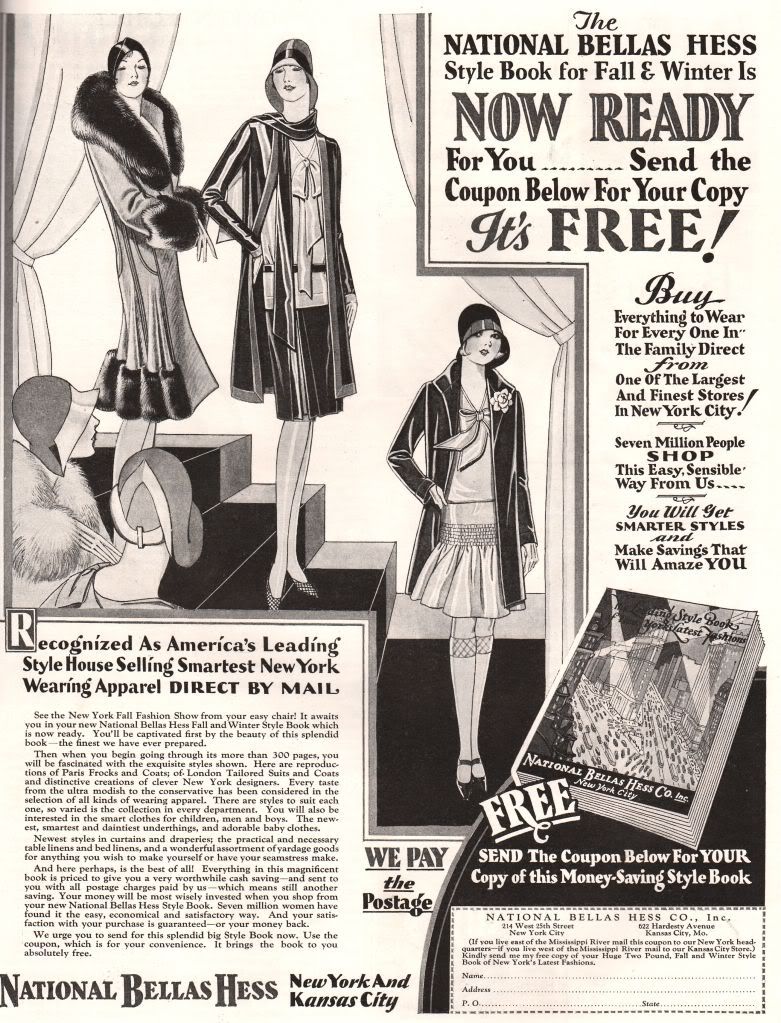
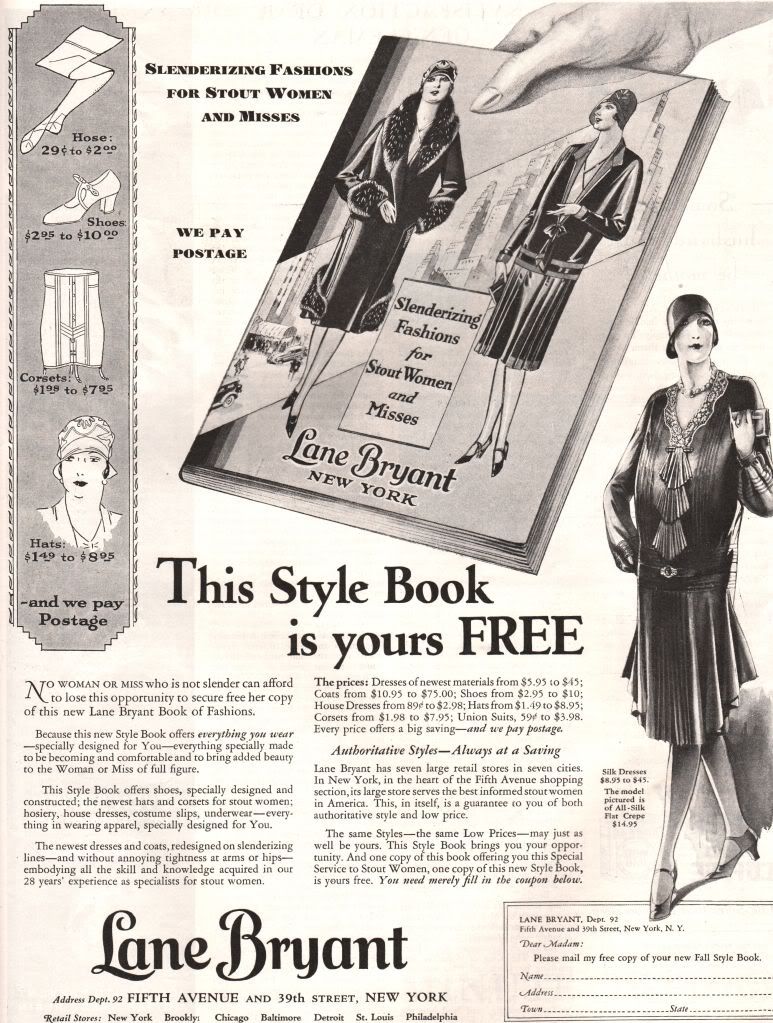
So many Mail Order Catalogs! 1929 - 1930

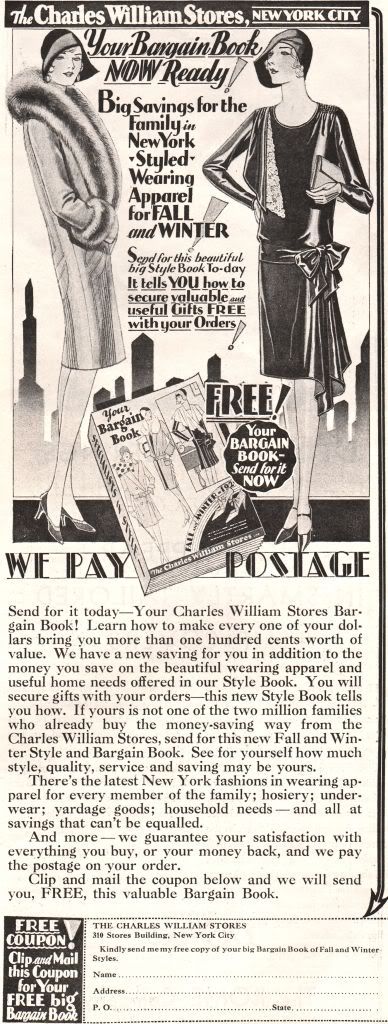
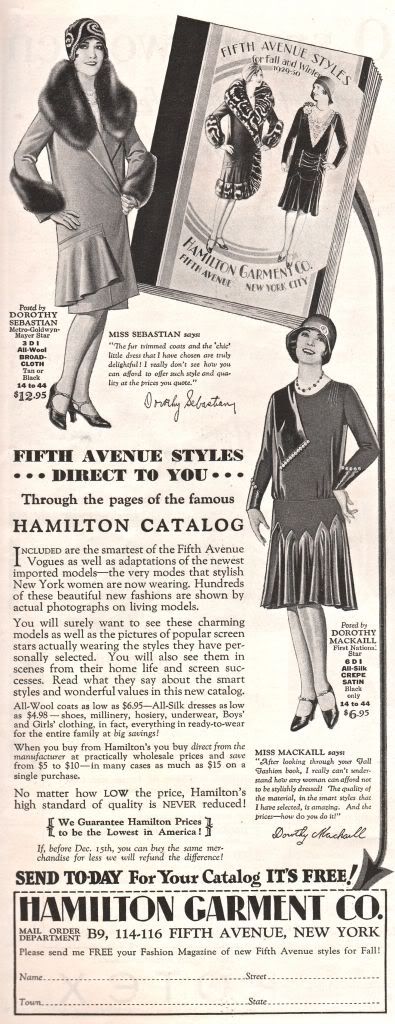
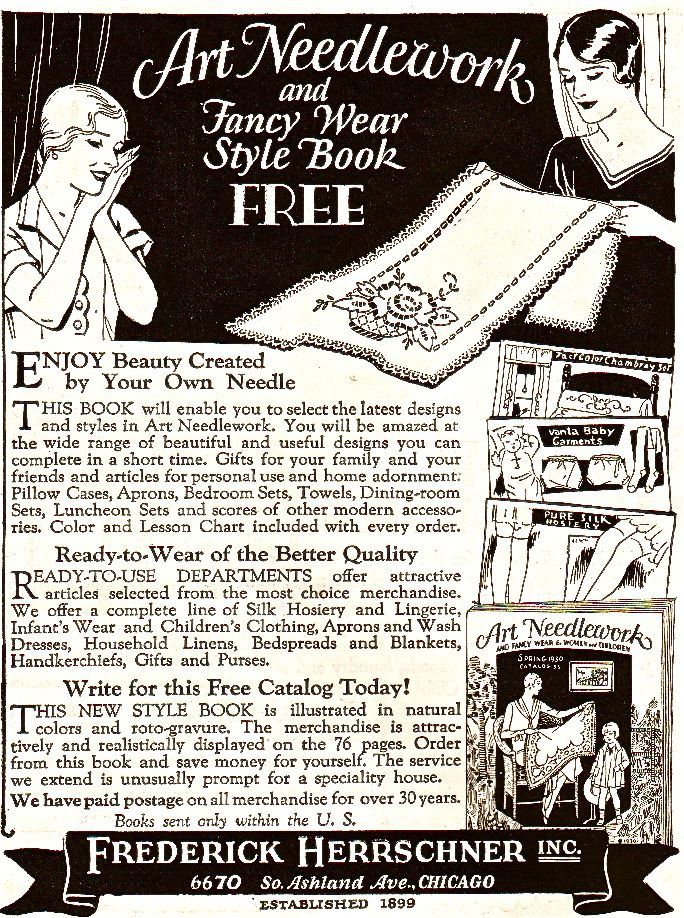
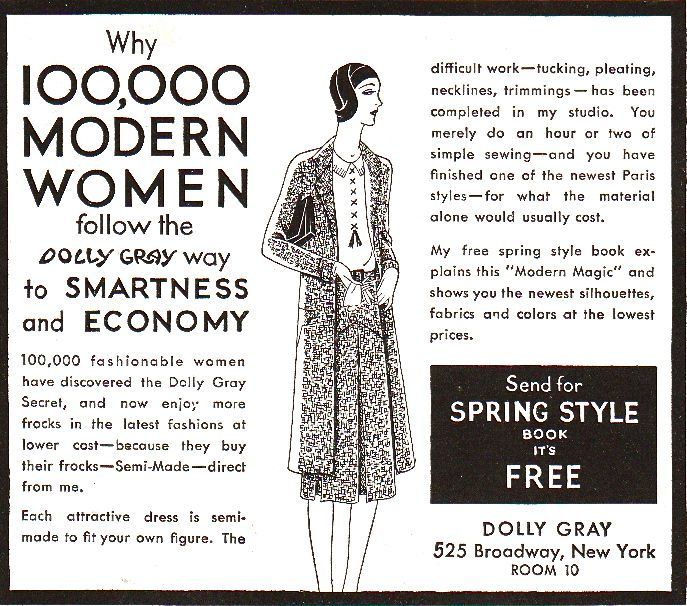
There are a few of the many fabulous catalogs you could choose from in 1929-1930. These advertised for urban shoppers, but also brought fashion to that rural small town gal who wanted to wear the latest thing.

The Charles William Stores started in 1913 in New York.
Did you know Lane Bryant started in 1904 selling maternity clothes?
I have posted about a 1940's Bella Hess catalog here.
The Hamilton Garment Company still sells fine shirts.
I only found more ads from Elmer Richards Company. Do you know more history of this Chicago business?
The Minneapolis Knitting Works had a long history before closing in 1952.
Frederick Herrschner Inc. is still in business today selling crafts.
And here is another ad from the Dolly Gray Company.

So there was no excuse for you or your family not to be well dressed!


Wednesday, October 31, 2012

My Mending Shelf - advice from 1930

This article caught my eye because while we might not have as much darning of stockings or deal with runners in your nylons, but you may still face a huge basket of mending. Mary Waterstone Stuart has a solution for you. Make a shelf with all your supplies at hand and before you realize it your task is done."Definite places for things are such a comfort."

"I used to look at our huge basket of family mending, I always dreaded the task ahead of me. Then one day a happy thought struck me. I had- attractive shelves for books, for dishes, for knives, and for kettles. Why didn't I have a little sewing shelf, which would measure up to the rest of the house, a shelf so attractive that it would lend a glamour to the whole task of mending? The reason I disliked mending, I suddenly realized, was because it meant such a terrible waste of time. My tools were never at hand. And so I had kept putting off the job from day to day and the mending collected and grew more and more discouraging.
My plan was quickly carried out. I made a shelf of three-quarter-inch board, three and a half inches wide and twenty-five inches long, with a back to serve as an additional rack. These dimensions make an adequate abiding place for all the articles I need in ordinary sewing and mending work, but offer no refuge for excess baggage. I painted my shelf a gay lacquer red, treating it as an ornament of the room, but I could have matched the color of the wall had I wanted to make it unobtrusive.
When I had completed the outfit I felt very proud of it and hung it in the room where I usually mend, while the children play around or bring me their clothes which need a button or an odd stitch or two. Of course, it was in a good light for both day and night work, and within easy reach of my low sewing chair.
On the back of the rack I drove in six brads at an angle, and on them placed a few necessary spools of thread. Black and white cotton in two weights—one for buttons and the other of lighter weight for hand and machine sewing—were all that I really needed. As I happen to use beige and black silk frequently I gave these a place also. These spools are merely slipped over the brads and can be changed at any time. There is no need to keep a large stock of thread and sewing silk on hand if you are within easy contact with the shops.
Darning stockings is an all important process, if there are children in the home. Also, runners in grown-up stockings are usually discovered just at the sound of the automobile which is to carry you to some special function. To meet both these needs, I have equipped my shelf with four balls of mercerized cotton in the colors most often used. Moreover, since I frequently have to take a stitch in a hurry, each colored cotton has its own needle and this needle I leave in its particular ball, threaded, and ready to use. Then I can arrive at the shelf, pause for a thread, and almost before I realize it, the task is done, and the needle replaced in its particular ball.
Of course, with this darning equipment must go a darning ball. Mine has a handle which will slip into the fingers of gloves, and I accommodated it to my shelf by neatly drilling a hole through the wood. To the thimble I assigned a special place and it is such a comfort to have it always bowing to me as I approach hastily instead of having to hunt for it.
Next on my shelf, I put two small duplex boxes, which are as gay as the heart could wish. These little things hold a few snaps and hooks and all the buttons which the family will need for a few weeks. Buttons are a product with which we are apt to over-supply ourselves. Actually we use very few.
Below the shelf I put a series of small cup-hooks. The first one holds a pincushion and the second a cushion for needles and needles only. I always have a safety pin or two present. I use them to draw various tapes and runners in bloomers and pajamas.
The next hook I definitely assigned to the tape measure. The next holds a woven band of colored darning threads. They are attractive, useful and inexpensive, and no mending shelf is really equipped without one. On the remaining two hooks I hung the scissors. I find two pairs sufficient; one for cutting and the other, a small pointed pair, for fine work. Definite places for things are such a comfort.
With this equipment on hand, even a large order of mending from a ten year-old son loses its deadly effect, and the running time, of all weekly mending is infinitely reduced."

Saturday, October 27, 2012

L'Echo De Paris - 1930 Fashions

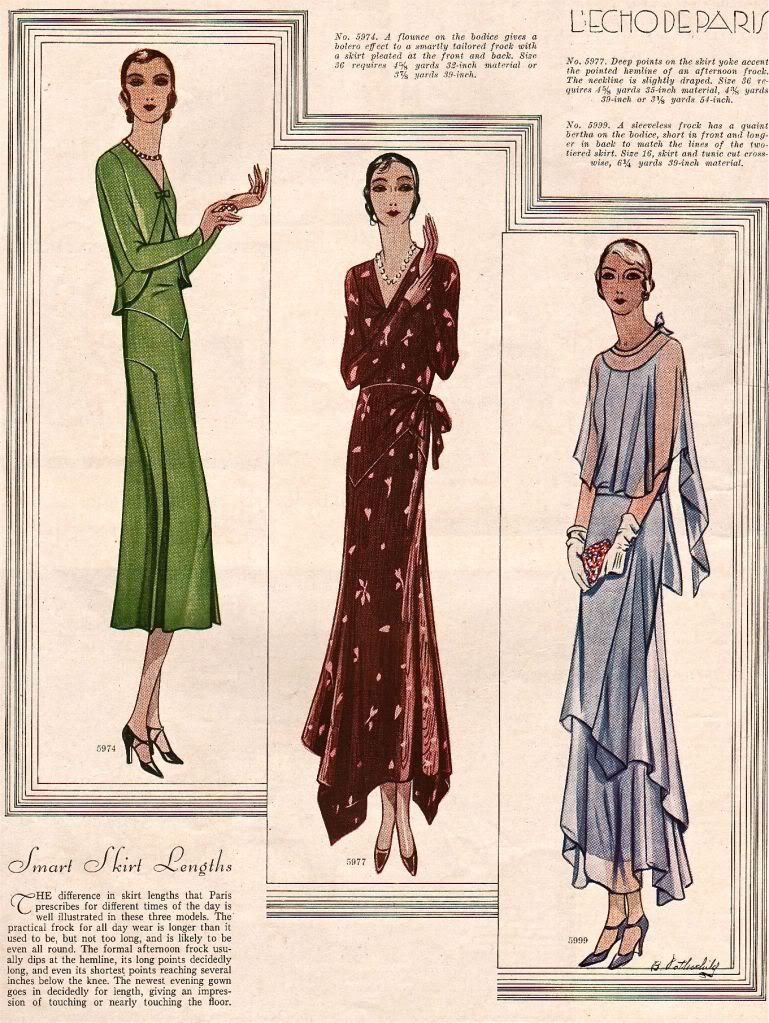
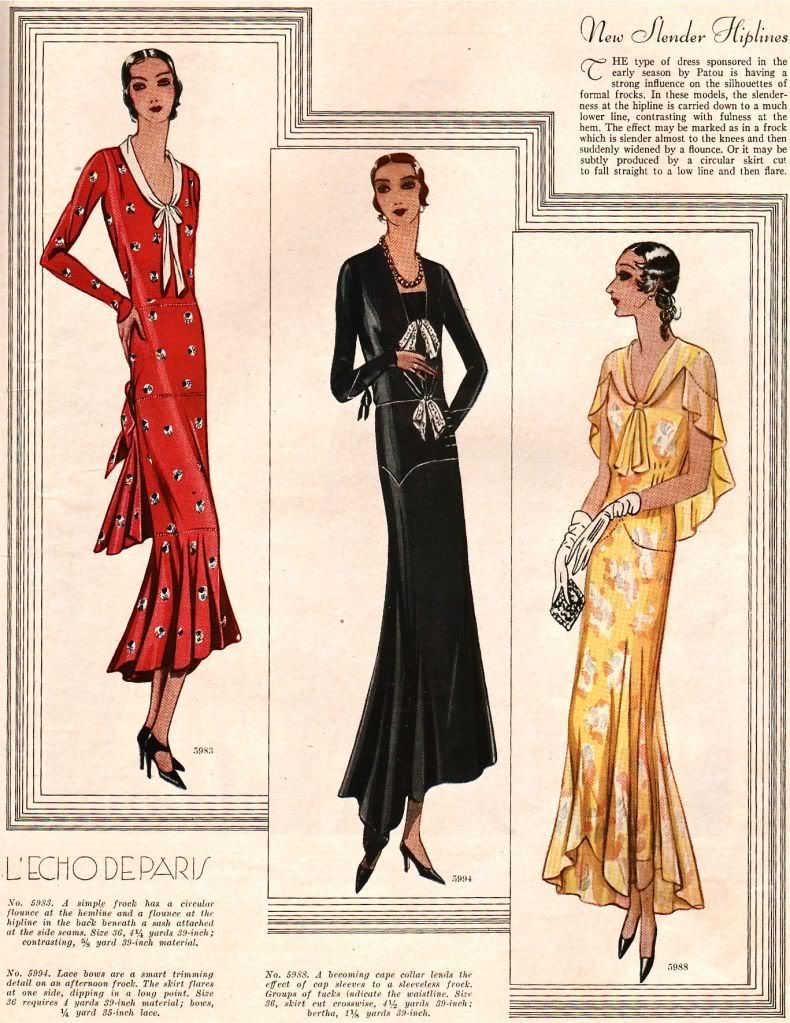
This 1930 issue of McCall's Magazine shows the latest styles from Paris. There are Smart Skirt Lengths and New Slender Hiplines.
These were patterns you bought to sew at home. How the 1930's sewing machines handled all this sheer draping fabrics cut on the bias reminds us just how good these seamstresses were.


"The difference in skirt lengths that Paris prescribes for different times of the day is well illustrated in these three models. The practical frock for all day wear is longer than it used to be, but not too long, and is likely to be even all round. The formal afternoon frock usually dips at the hemline, its long points decidedly long, and even its shortest points reaching several inches below the knee. The newest evening gown goes in decidedly for length, giving an impression of touching or nearly touching the floor."

"The type of dress sponsored in the early season by Patou is having a strong influence on the silhouettes of formal frocks. In these models, the slenderness at the hipline is carried down to a much lower line, contrasting with fulness at the hem. The effect may be marked as in a frock which is slender almost to the knees and then suddenly widened by a flounce. Or it may be subtly produced by a circular skirt cut to fall straight to a low line and then flare."

Friday, April 16, 2010

The Woman's Institute - Designing And Decorating Clothes - Part 2

This is another of these Womans Institute books, this is called Designing And Decorating Clothes, copyright 1930. All of these books are made up from earlier articles, with earlier copyright dates. This one has lots of lined drawings and instructions on clothing design.
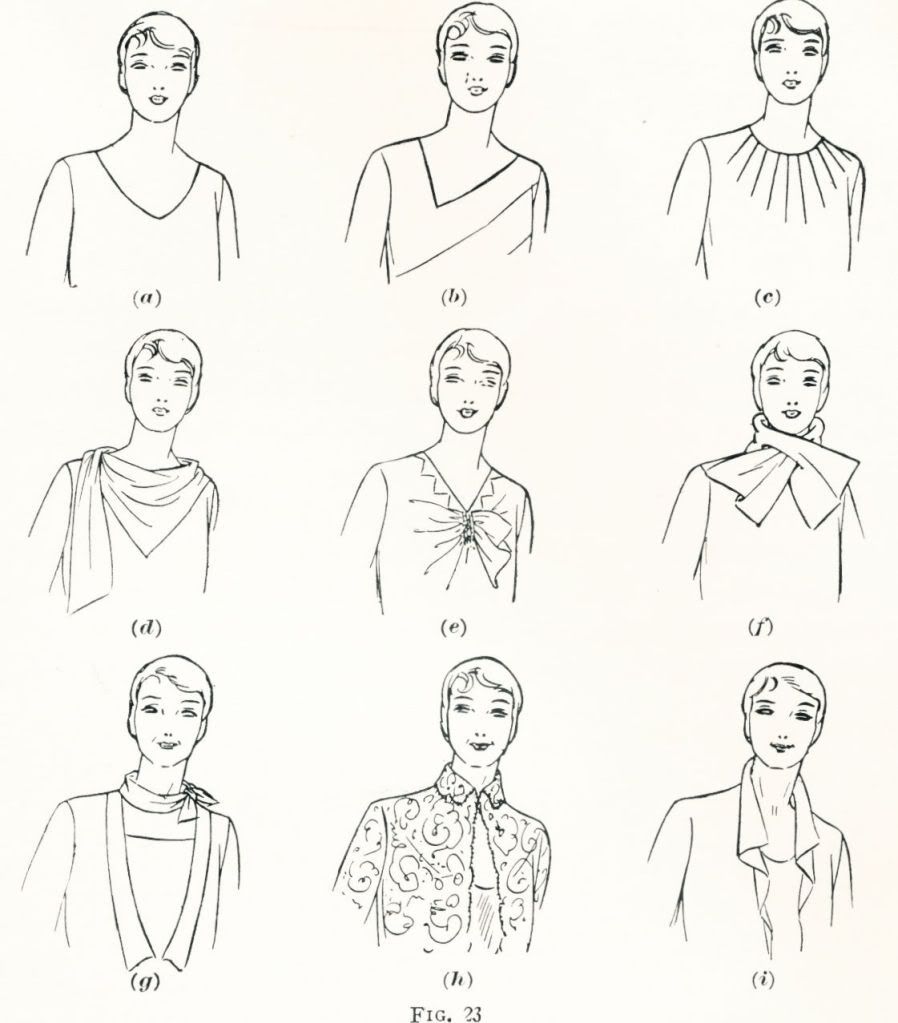

"The ideal, or average, figure that has an attractive, well-proportioned oval face with regular features, can wear almost anv neck line that pleases her. However, even slight irregularities of feature, the length and fulness of the throat, and the way in which the hair is worn, all have a bearing on the manner in which the neck line of the dress may be shaped and finished. It is, therefore, necessary to study all these points so as to design becoming necklines, for the neck line frames the face and greatly affects the apparent size and contour. In designing, however, it is important to work for harmony between the neck finish and the rest of the design. various neck lines that can be worn by the average figure, or by other figures whose face, neck, and shoulders are approximately average, are shown in Fig. 23."
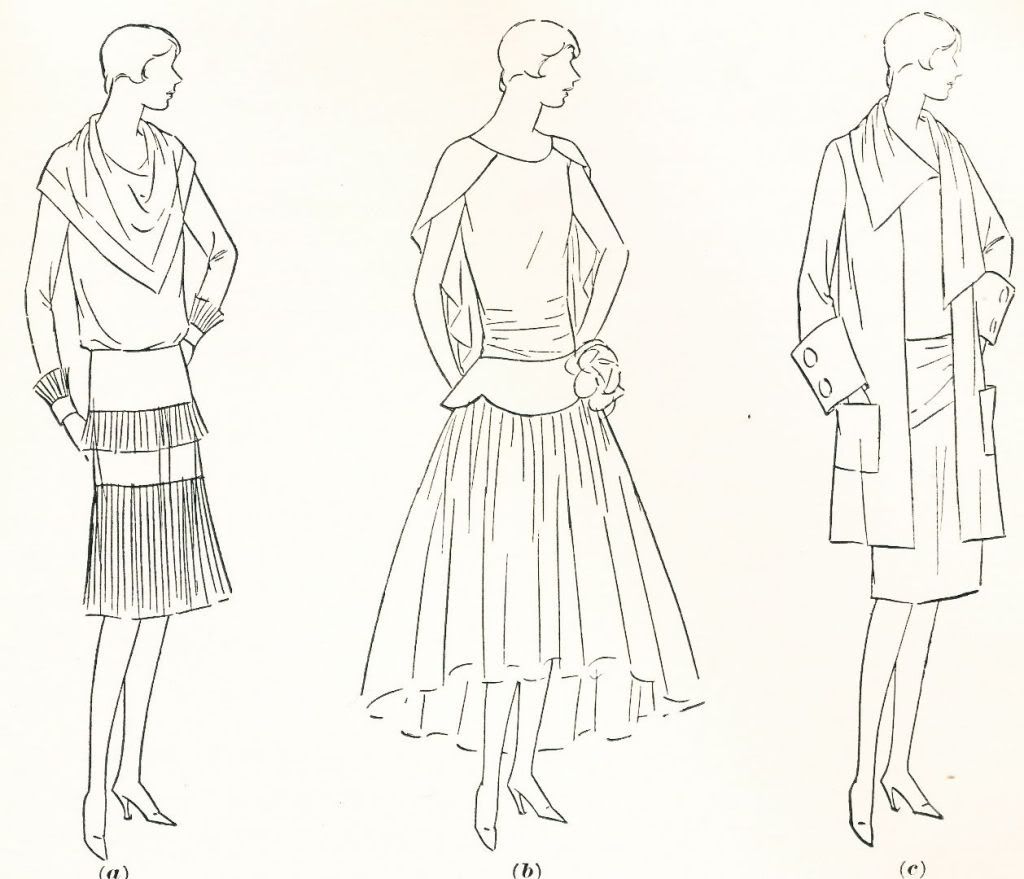
"Dress and Wrap Designs.-The most desirable effect to gain is one of grace and softness, rather than severely tailored ones, but because it is very easy to cross the line into fussiness when striving for such effects, it is essential that the designing be carefully done, for smartness must never be sacrificed. Among certain types of tall, slender women, there is a tendency to affect the picturesque in dress, and while such a plan is sometimes feasible when a woman may have a great many clothes, it is safer to keep away from this sort of clothes, except for such special occasions as call for them."
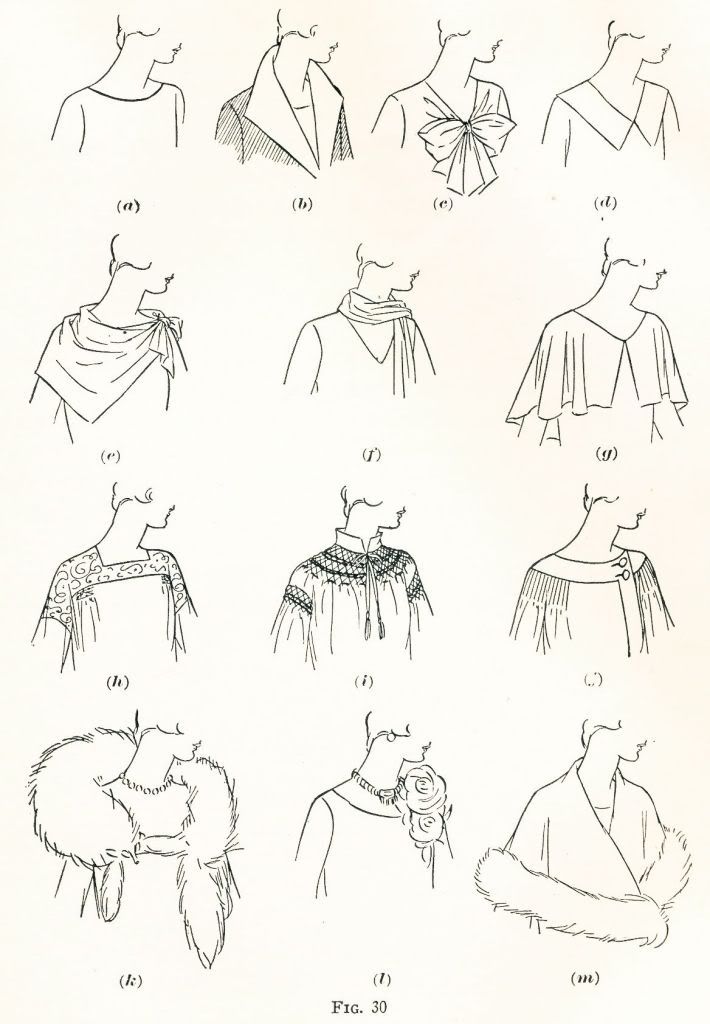
"Neck and Shoulder Treatments.-The tall slender figure is usually thin in the neck and shoulders, but there are all sorts of designing features that may be employed, as Fig. 30 shows, to overcome such defects. Sometimes these pertain to the neck alone and again are so developed as to embrace the shoulders. And frequently, accessories may be called upon to lend their help in creating the illusion of greater bulk."
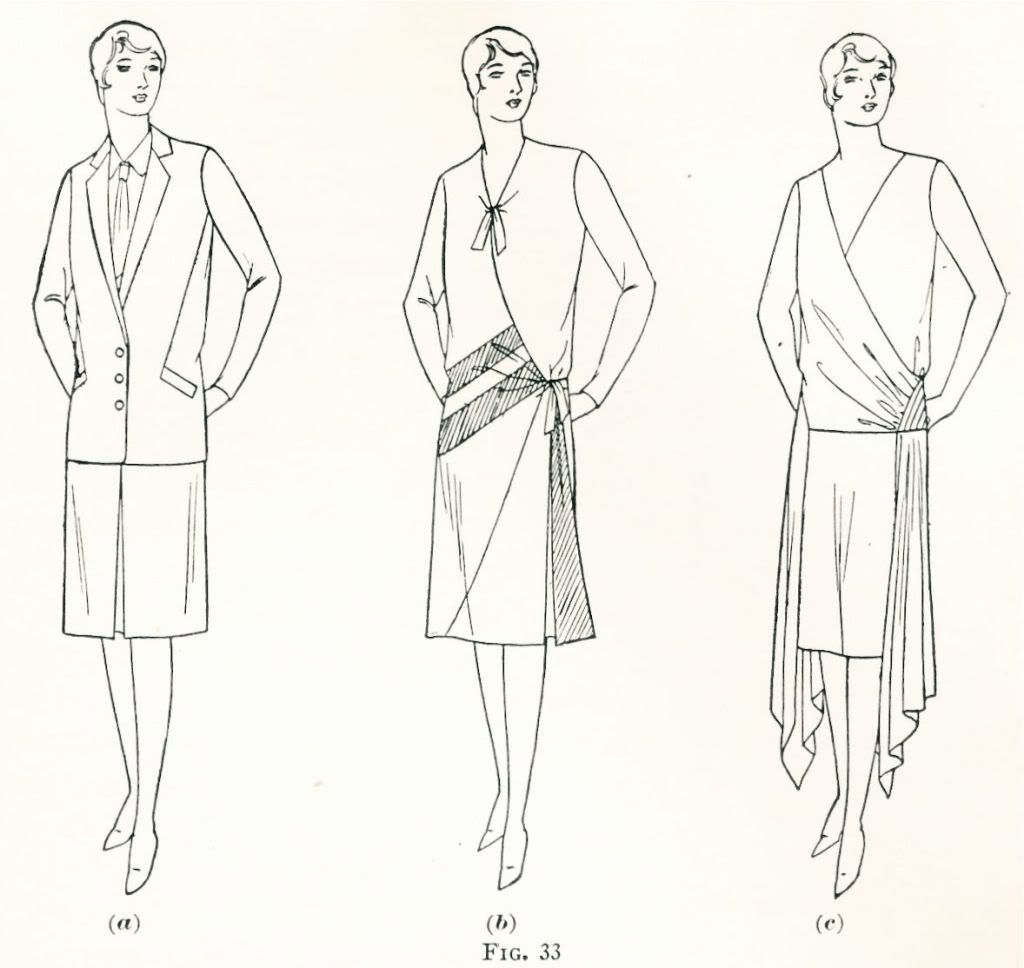
"Dress Designs.-Smartness for this type ties largely in tailored simplicity, in restrained decoration, and in richness of effect. Ruffles, excessive flares, or features that suggest fussiness must be shunned, while at the same time lengthening lines must not be overemphasized because of her height. A tailored, an afternoon, and an evening costume suitable for this figure are given."
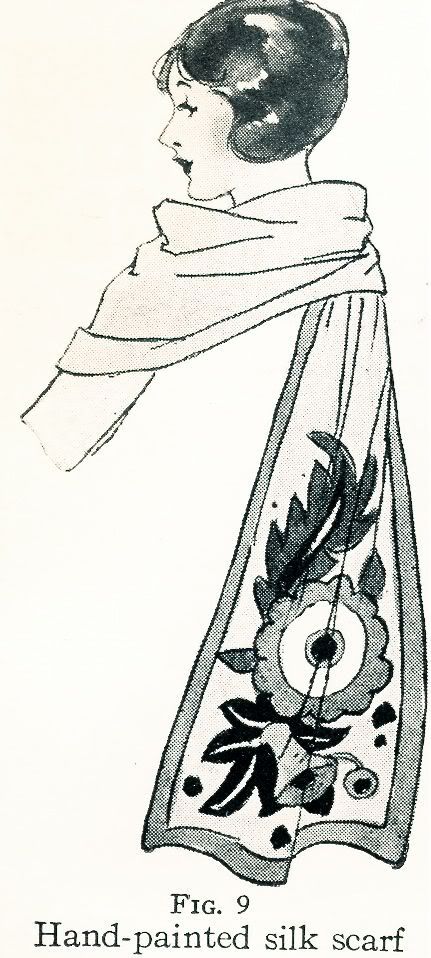
"Painted Designs-Painting designs on fabric to beautify it was, a very early form of decoration. It was probably first employed by primitive civilizations while weaving was still in a crude state, but its use has persisted throughout the entire history of textiles. Painted or stenciled designs on fabrics have not, until recently, been permanent and so could not be so strongly recommended, though the beautiful silk ball gown worn by Martha Washington, and now preserved in the Smithsonian Institution, was painted all over
with a charming flower design, and some of the lovely scarfs imported from France and Russia, a copy of one of which is shown in Fig. 9, are painted with great success in vigorous forms and strong colors in the manner of the futurist art. With the recent developments in paints and dyes, however, the art of fabric painting has been so improved that beautiful and lasting effects can now be obtained."
Monday, September 28, 2009

Paris Frocks At Home - 1930 (Part 6)


Capes and bertha collars are rejuvenating.

"Have you ever considered removing the sleeves from your last season's dress and adding a capelet at the armhole or a cape collar or a bertha at the neckline? One of the most successful Sunday supper frocks of the season is an inspiration for just this treatment.

Full capelets of net are set into the armholes of a black satin frock, a net yoke fills in the neck and the hem is transparent net for at least 13 inches.

The Deltors of new Butterick patterns will show you how to cut and apply these touches to your old frocks. Patterns, Nos. 2996 and 3004 were the source for the good looking capelet collar on this page and the smart bertha on the next. The little tie, in both cases, adds a soft flattering touch at the point of the V.

These collars and berthas are particularly good in chiffon, georgette or soft silk crepe."

Butterfly bows are effective.

"If you like a perky touch, try a butterfly bow at the joining of your bertha collar in the front. Illustration 168 shows you how to make it, gathering it through the center. It may be inserted through two vertical slashes or shaped in a double bow and tacked at the center front as shown in illustration 169. The tie should be cut as in illustration 165, slightly shaped through the center, and made with a rolled hem."

Sunday, September 27, 2009

Paris Frocks At Home - 1930 (Part 5)

Sport clothes demand tailored necklines.

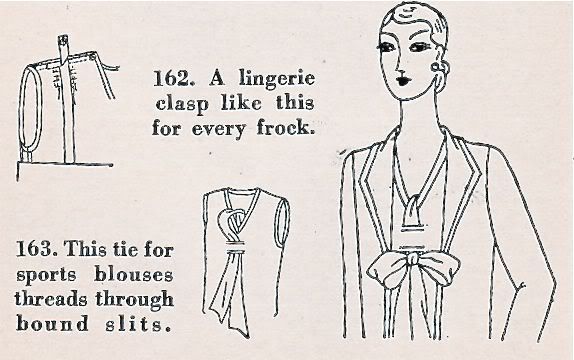
"An effective use of the straight tie for blouses is shown in illustration 163."

Do this to any old blouse.

"Make your tie.double and cut the ends slanting. Slip the tie over the neckline and draw the ends out through two horizontal bound slashes and loop or tie in a bow.
You'll see this finish on many smart frocks.

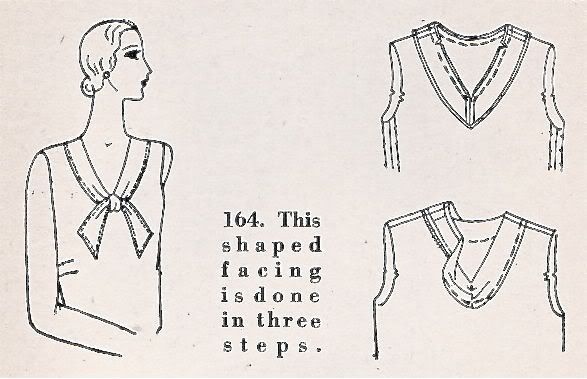
A shaped facing applied to the neckline of a sports blouse is often used with a little suggestion of fullness at the center front over which is tacked a softly made knot. (Illustration 164.) Stitch the right side of your facing to the inside of the blouse. Turn it toward the outside, gather the center front of the facing and draw it up slightly. Baste and stitch the turned-in edges of the facing down to your blouse. Make a knot, tack at the center front, and stitch the turned in edges of the ends down to your blouse.

Occasionally the ends of the facing are cut long enough to make the knot in one with the facing. The Deltor will show you how to do this."

Saturday, September 26, 2009

Paris Frocks At Home - 1930 (Part 4)


Fresh touches for little girls' dresses.

"The Deltor will show you how to cut a shaped facing for the neckline of a child's dress with ends to cross in front, and how to stitch it to the inside of the neckline and fold it over to the outside. The ends of the little tabs are turned in and the right tab is lapped over the left one and the whole stitched down.

Illustration 160 varies this by lining the two ends of the facing, and making a bound buttonhole in each tab. The tabs are not stitched down to the frock but are buttoned down with buttons sewed on each side of the center front."

"There are many clever little touches that you can add to the necklines of last year's frocks and jackets that will make a youngster's eyes sparkle. Illustration 161 shows two little buckles posed each side of a neck with a band threaded through them. This doubled band is stitched down across the back to form the tailored collar."

Friday, September 25, 2009

Paris Frocks At Home - 1930 (Part 3)


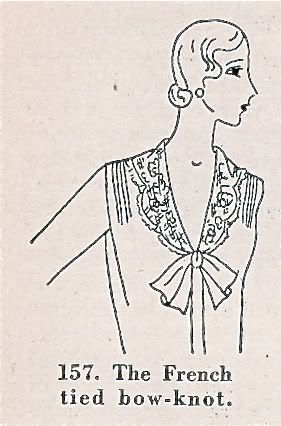
The French bow knot.
"This same type of strip may be tied in a soft knot and used at the point of a V neckline with a collar of similar material tucked at the neckline to fit around the curve at the back of the neck and over the shoulder."

The lingerie touch.
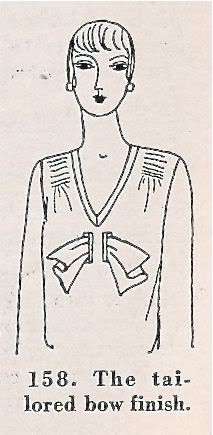
"It is surprising how much a fresh lingerie touch in the form of a bow or a collar will do to modernize last season's dress. The Deltor is full of unusual suggestions for making the little collars and cuffs, bandings and chic lingerie bows that look so casual and so truly French. The mannequins on this page show two smart versions of the lingerie bow. Cut a straight strip of organdie, voile or batiste. Roll and whip or make a narrow hem around the four edges. You may have them picoted if you wish but hand work on lingerie details is always more desirable. Now make two bound vertical slits on the front of your blouse and gather your hemmed strip through the center and thread it through the slits. (Illustration 158.)"

Thursday, September 24, 2009

Paris Frocks At Home - 1930 (Part 2)


Reclaim worn sleeves.

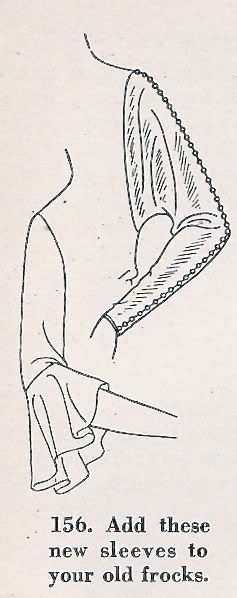
"So often sleeves wear out before their time. Butterick has prepared - special patterns to replace them.

If a sleeve is worn at the elbow, cut it off here and combine it with lace or chiffon (Ill. 155), or add a flare below the elbow, (Ill. 156). If it requires a whole new sleeve, give it dolman sleeves of contrasting fabric in matching color-chiffon sleeves for a velvet frock or velvet sleeves for a crepe frock."

Wednesday, September 23, 2009

Paris Frocks At Home - 1930 (Part 1)

This week we are going to look at "Paris Frocks At Home" a book put out by Butterick in 1930. This has general sewing advice and lots of encouragement for using patterns, especially Butterick Delineator patterns, of course. There is quite a bit about keeping up with the newest Paris fashions, so here's a few of their suggestions for making over your old wardrobe.


"It has always been true: costumes individually created have that indefinable quality of charm that never fails to win interest and approval."

Make a Parisian wardrobe from your good American dresses.

"As each new season approaches you will want to survey the possibilities of the clothes you have on hand. It seems a pity to discard a favorite frock. We would suggest that you bold over promising frocks to study what can be done to make them conform to the new season's fashions.
Last year's afternoon frock that is too short for this year of grace can be dropped low from a yoke of lace to make a stunning Sunday night frock with angel sleeves. The vogue for tunics is a blessing to those of us who have hoarded knee length frocks. Skirts that seemed a total loss can now be lowered to decent length on bodice tops and combined with a new tunic blouse of lame or satin, or you can reverse the English and make a knee-length tunic of a too short frock, combining it with a new skirt. (Ill. 154.) You can make an ankle length dance frock by cutting off last year's dipping hemline evenly below the knees and adding an 18" band of tulle."